
You walk into a retail shop or general trade outlet in India. You will see something that would have been unthinkable a decade ago – the retailer behind the counter placing an order on a mobile-based retailer ordering app, checking loyalty points, browsing the latest trade scheme, etc., all without waiting for a salesperson to visit. This shows how technology is changing the way retailers, distributors, and brands work together.
FMCG & CPG brands are searching for smarter ways to engage shop owners, capture market demand, strengthen distribution performance, and gain greater visibility into their route-to-market operations. Across the retail industry, at the same time, most of the retailers are increasingly adopting digital tools to streamline their operations, improve customer service, and manage their stores more efficiently.
This shift has given rise to retailer apps, sometimes referred to as dealer apps depending on the industry or company. These are digital platforms that enable retailers to interact with brands and distributors. Depending on the platform and integration, retailers may be able to place orders, discover new products, view schemes, track loyalty rewards, access invoices, and stay informed about the latest updates, all at their convenience.
Why Retailer Engagement Is Evolving?
Meanwhile, most of the brands are demanding more from their distribution strategies. They need faster order processing, stronger retailer engagement, better secondary sales visibility, more accurate demand data, and the ability to execute and measure trade scheme programs without relying entirely on field-team interventions.
This is where a retailer application platform becomes important. More than just an order-taking tool, it serves as a dedicated digital channel that connects brands, distributors, and retailers on a single platform.
By providing a centralised, always-accessible interface for retailers, dealer management applications help brands strengthen retailer relationships, improve distribution efficiency, increase secondary sales visibility, and create a more connected retail ecosystem.
Whether you’re a sales leader, distribution manager, trade marketing professional, digital transformation strategist, or FMCG decision-maker evaluating retailer engagement solutions, understanding how retail ordering apps work is becoming increasingly important.
In this blog, we’ll explore what a retailer ordering app is, how it works, its key features and benefits, and the various ways FMCG and CPG brands are using it to modernise retailer engagement and drive business growth.
Table of Contents
What is a Retailer Ordering App?
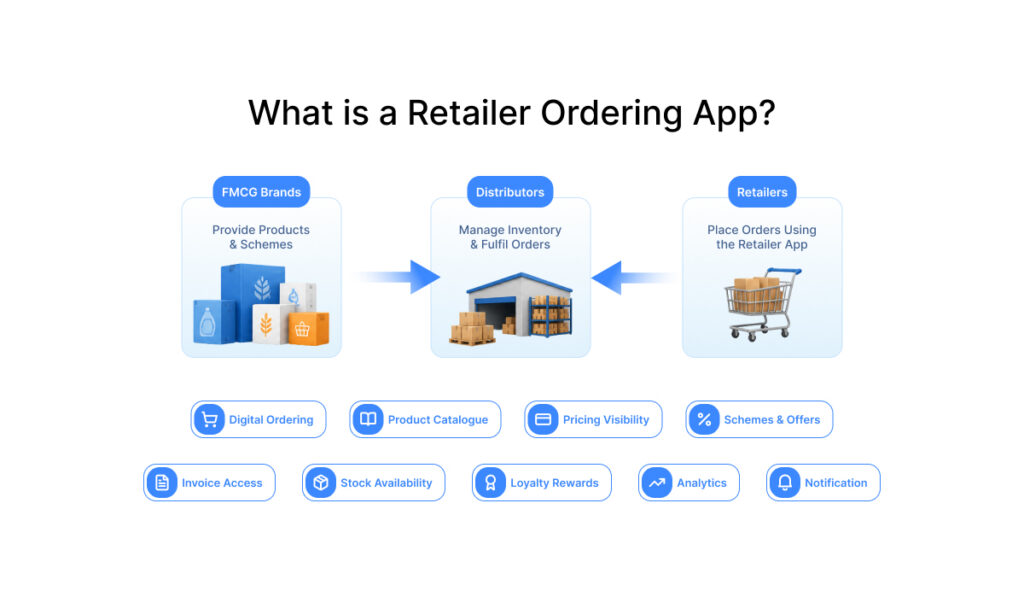
A retailer ordering application is a digital solution that enables retail shop owners to interact directly with distribution brands and distributors through a mobile or web application.
Key Functions of a Retailer Ordering Application Include:
- Digital order booking
- Browse product catalogue
- Transparency & pricing visibility
- Access to promotional schemes & offers
- Loyalty points tracking & redemption
- Retailer engagement
- Stock availability for each product
Challenges Distribution Brands and Retailers Face Without a Dealer Management Application
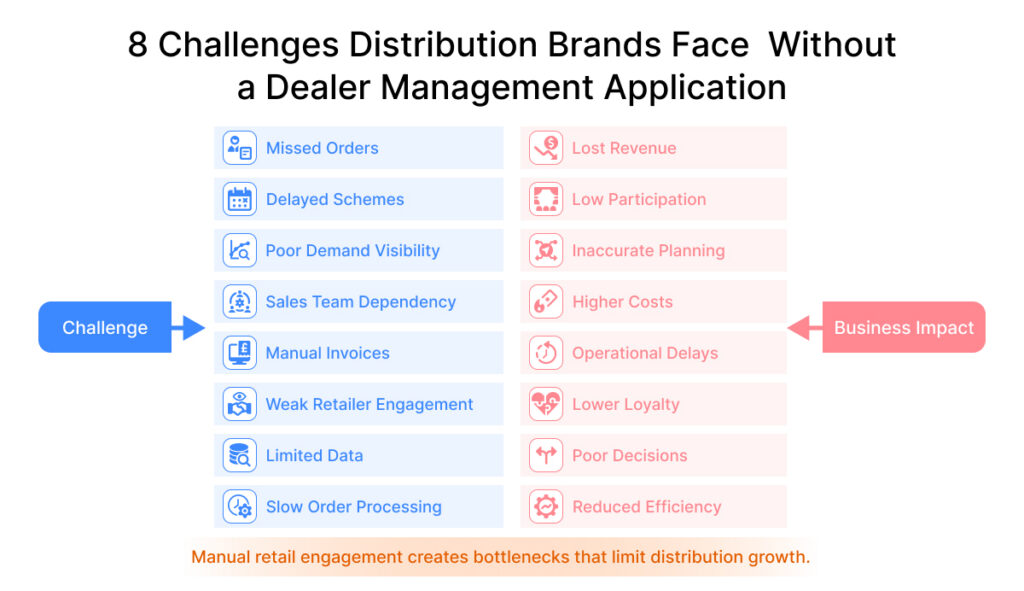
For decades, retailer engagement relied heavily on manual processes. Sales representatives visited outlets on fixed beat cycles to collect orders, promotional schemes were communicated through paper, stock updates were shared over phone calls or WhatsApp messages, and invoices were often managed through disconnected systems. These methods worked when distribution networks were smaller and product portfolios were limited; now they have become increasingly difficult to manage as markets expand and retailer expectations evolve.
The challenges are familiar to most FMCG and CPG companies:
- Missed orders
- Delayed scheme communication
- Low participation in loyalty programs
- Limited visibility into retailer demand
- Overdependence on field sales teams for routine interactions.
As distribution networks grow, these inefficiencies create operational bottlenecks that directly impact sales, retailer satisfaction, and market responsiveness.
The pressure to modernise has come from multiple directions. E-commerce platforms have demonstrated that ordering can be instant, self-service, and frictionless. Retailers, many of whom are now comfortable using smartphones and digital payments, expect the same convenience from the brands they work with. They want the ability to browse products, place orders, view pricing, access invoices, track loyalty rewards, and stay informed about schemes anytime and from anywhere.
Research by Redseer on India’s kirana eCommerce and digital B2B market highlights the scale of India’s general trade market and the growing role of eB2B platforms in serving local retailers.
Without a retailer ordering app, both brands and retailers often face the following challenges:
Dependence on Sales Representatives for Order Booking
Many retailers still rely on field sales representatives to place orders during scheduled visits. This can delay order placement and limit retailers’ ability to replenish product stock when required.
Missed Orders and Lost Sales Opportunities
Phone calls, WhatsApp messages, & manual order booking processes can result in missed orders, communication gaps, & order inaccuracies, ultimately affecting sales performance.
Low Visibility into Product Availability & Pricing
Retailers often lack real-time access to product catalogues, retail prices, & stock availability, making inventory planning more difficult.
Low Awareness of Schemes & Promotions
Promotional schemes & trade offers may not reach every retailer at the right time. When scheme communication is inconsistent or difficult to access, retailer awareness and participation can be affected.
Invoice Management & Record-Keeping Challenges
Managing invoices through multiple systems can create inefficiencies for retailers. Accessing organised digital invoices, order history, & transaction records often becomes a time-consuming process.
Poor Retailer Engagement
Without a dedicated retailer app or retail mobile app, communication between brands and retailers remains fragmented. Important updates, product launches, and promotional announcements may not effectively reach retailers.
Limited Retailer-Level Data and Insights
Brands often struggle to gain visibility into retailer ordering patterns, buying behaviour, and demand trends, limiting their ability to make data-driven decisions.
Slower Order Processing Cycles
Manual order collection and processing can increase turnaround times, slowing down order fulfilment and impacting overall supply chain efficiency.
These challenges have led many distribution-led companies to adopt retail management software that enables digital order placement, organised invoice management, improved retailer engagement, and better visibility across the distribution network.
Key Features of a Retailer Application Platform
- Digital Ordering and Reordering
- Digital order placement
- Order history
- Quick reorder from previous purchase
- Cart management
- Product, Pricing, and Stock Visibility
- Product catalogue
- Product search and filtering
- Retail pricing visibility
- Product availability
- Invoice Management
- Digital invoices
- Order records
- Loyalty, Schemes, and Retailer Engagement
- Loyalty programs
- Rewards management
- Scheme visibility
- Promotional offers
- Communication and Distributor Collaboration
- Notifications and alerts
- New product and offer updates
- Simplified communication with distributors
- Analytics and Secondary Sales Visibility
- Outlet performance tracking
- Retailer order and sales data visibility
- Analytics and reporting
Benefits of Retail Management Software
Retail management software creates value for every stakeholder in the distribution ecosystem. Retailers gain a faster and more convenient way to manage orders and business operations, while distribution-led brands benefit from stronger retailer engagement, improved visibility, and more efficient distribution management. The table below highlights the key benefits for both retailers and brands.
Benefit Area | For Retailers | For Distribution-led Brands |
Order Management | Faster order booking and easy reordering from anywhere | Reduced order processing time and improved order accuracy |
Stock Management | Better visibility into stock availability and product information | Improved demand forecasting and inventory planning |
Scheme & Promotions | Easy access to schemes, discounts, and promotional offers | Improved scheme visibility and potential for better participation |
Invoices & Records | Access to organised digital invoices and purchase history | Reduced manual administration and fewer billing disputes |
Retailer Engagement | Direct communication with brands and distributors | Stronger retailer relationships and improved engagement |
Business Visibility | Better visibility into orders, loyalty status, and purchase history | Better secondary sales visibility and retailer-level insights |
Loyalty Programs | Earn, track, and redeem rewards more easily | Supports retailer engagement and loyalty initiatives |
Market Reach | Access to products and offers anytime through a retail mobile app | Faster market coverage through an additional route-to-market channel |
Operational Efficiency | Reduced dependency on sales representative visits | Lower operational costs and improved distribution efficiency |
Key Outcomes of a Retailer Ordering App
For retailers, a retailer app simplifies day-to-day operations by making order placement, stock management, invoice access, and scheme participation more convenient. For distribution brands, it acts as a powerful retail solution that improves retailer engagement, increases visibility into secondary sales, strengthens retailer loyalty, and enables more scalable distribution growth.
As a result, both retailers and brands benefit from a faster, more connected, and more efficient distribution ecosystem.
Retailer Application Platform vs. Other Traditional Retail Management Tools
Dealer application platforms are often compared with traditional order-taking methods. While each plays a different role in retail operations, they also serve very different purposes.
Retailer Application Platform vs. Traditional Order-Taking Methods
Area | Traditional Order-Taking Process | Retailer Application Platform |
Order Collection | Orders collected through sales representatives, phone calls, or WhatsApp | Retailers place orders directly through the app |
Scheme Communication | Shared manually during sales visits or through messages | Available instantly within the application |
Retailer Engagement | Limited to periodic interactions | More frequent digital engagement |
Data Visibility | Limited retailer-level visibility | Timely access to retailer and order data |
Order Accuracy | Higher risk of manual errors | Reduced errors through digital order placement |
Sales Dependency | Heavily dependent on field sales teams | Enables self-service ordering for retailers |
Order Processing Time | Slower due to manual intervention | Faster and more digitised order processing |
Invoice Access | Often fragmented across multiple systems | Digital invoices available within the platform |
Best Practices for Successfully Implementing a Retailer Ordering Application
Implementing a retailer ordering application is not just about launching a new digital tool. Its success depends on how effectively retailers adopt and use the platform in their daily operations. Distribution brands that focus on retailer experience, engagement, and long-term value are more likely to achieve higher adoption rates and better business outcomes. Here are some best practices to ensure a successful implementation:
1) Prioritise Ease of Use
Retailers should be able to navigate the platform and place orders with minimal effort. A simple, intuitive interface helps encourage adoption, especially among retailers who may be transitioning from manual order-taking processes. Features such as easy product search, quick reordering, and a mobile-friendly design can significantly improve the user experience.
2) Offer Meaningful Retailer Incentives
Retailers are more likely to engage with a new platform when they see clear value in using it. Depending on the business model, brands can encourage adoption through exclusive app-only offers, loyalty rewards, promotional schemes, or early access to new product launches.
3) Integrate with Existing DMS and SFA Systems
To maximise efficiency, the dealer application platform should seamlessly integrate with Distributor Management Systems (DMS) and Sales Force Automation (SFA) solutions. This ensures smooth order processing, real-time inventory visibility, accurate reporting, and a consistent flow of data across the distribution network.
4) Provide Training and Onboarding Support
Even the most user-friendly retailer app may require some level of onboarding. Providing training sessions, user guides, videos, and distributor support can help retailers understand the platform’s features and become comfortable using it for order placement and business management.
5) Continuously Engage Retailers
Retailer adoption should not stop after the initial launch. Brands should regularly engage retailers through product updates, promotional campaigns, loyalty programs, notifications, and personalised communication. Continuous engagement helps keep retailers active on the platform and strengthens long-term relationships.
6) Monitor Adoption and Gather Feedback
Track retailer usage, order frequency, and engagement levels to understand how the platform is performing. Collecting retailer feedback can help identify improvement opportunities and ensure the platform continues to meet retailer needs as the business grows.
7) Align the App with the Retailer’s Existing Workflow
A retailer app should fit naturally into the retailer’s existing workflow, making tasks such as ordering, checking schemes, viewing order history, and accessing invoices simple and convenient. The goal is to simplify existing processes rather than force retailers to completely change how they work.
Key Takeaway
The most successful retail management software combines ease of use, strong retailer incentives, seamless system integration, effective onboarding, and ongoing engagement. When implemented correctly, they can improve retailer adoption, strengthen retailer relationships, and deliver greater visibility and efficiency across the distribution network.
What to Look for When Choosing a Dealer Management Application
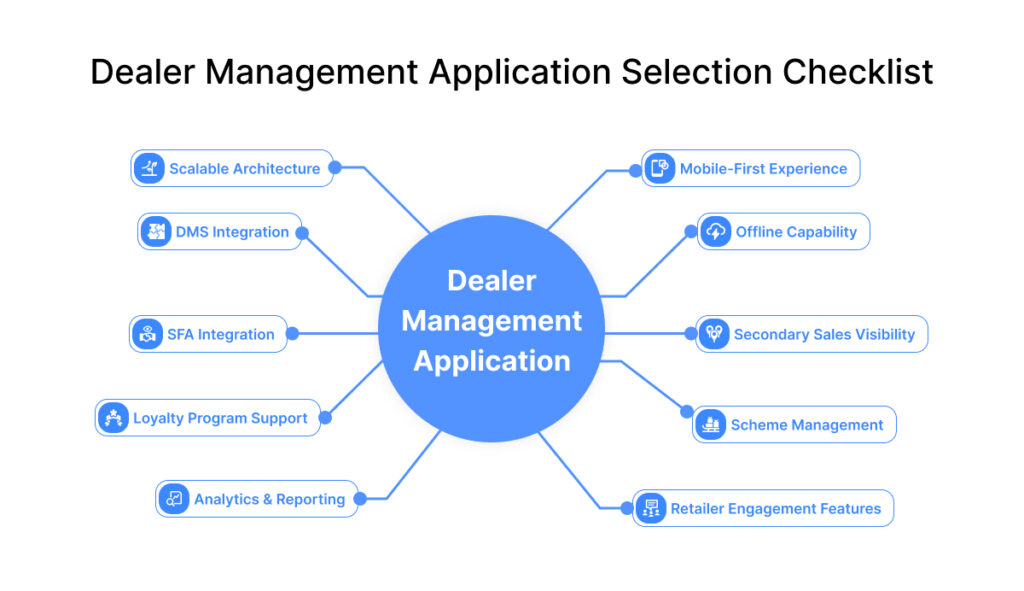
Not all retailer applications offer the same capabilities. As brands evaluate different solutions, it’s important to choose a platform that not only addresses current business requirements but can also support future growth and evolving distribution needs. Here are some key factors to consider when selecting a retail management solution:
1) Scalability
The platform should be able to support a growing network of retailers, distributors, products, and transactions without compromising performance. A scalable solution ensures that the dealer app can grow alongside your business.
2) DMS Integration
Seamless integration with your Distributor Management System (DMS) is essential. This enables real-time order processing, inventory synchronisation, invoice generation, and improved visibility across the distribution network.
3) SFA Integration
A retailer application should work alongside your Sales Force Automation (SFA) platform. Integration helps sales teams, distributors, and retailers operate from a single source of truth while improving coordination and data accuracy.
4) Loyalty Program Capabilities
Retailer loyalty programs can significantly improve engagement and retention. Look for a platform that allows retailers to earn, track, and redeem rewards while enabling brands to manage incentive programs efficiently.
5) Analytics and Reporting
Access to real-time analytics and reporting is critical for making informed decisions. The platform should provide insights into retailer activity, order trends, scheme performance, product demand, and secondary sales performance.
6) Mobile-First Experience
Since most retailers access applications through smartphones, the retailer app should offer a simple, intuitive, and mobile-friendly experience. Easy navigation and quick order placement can significantly improve retailer adoption.
7) Offline Capabilities
In many markets, internet connectivity may not always be reliable. Offline functionality allows retailers to continue browsing products, capturing orders, and accessing important information even when connectivity is limited.
Quick Evaluation Checklist
Before selecting a retailer application platform, ask the following questions:
- Can it scale as the business grows?
- Does it integrate with existing DMS and SFA systems?
- Does it support retailer loyalty and engagement programs?
- Does it provide robust analytics and reporting capabilities?
- Is it optimised for mobile devices?
- Can retailers use key features in offline mode?
- Does it provide visibility into orders, schemes, and secondary sales?
Choosing the right dealer application platform can have a significant impact on retailer adoption, distribution efficiency, and long-term business growth. The ideal solution should not only simplify order management but also strengthen retailer engagement and provide the visibility needed to make better distribution decisions.
Retailer applications have evolved from being a competitive advantage to becoming a core part of modern FMCG and CPG distribution. As retailer expectations shift toward faster, more convenient, and self-service interactions, brands can no longer rely solely on traditional order-taking methods and field sales visits.
Retailer apps are becoming a critical route-to-market channel. A dealer application platform does more than digitise order booking. It creates an additional digital route-to-market channel that enables retailers to place orders, access schemes, track invoices, and engage with brands anytime and from anywhere. The benefits extend to every stakeholder. Retailers gain a faster and more convenient ordering experience, distributors improve operational efficiency, and brands achieve stronger retailer engagement, better secondary sales visibility, and faster market coverage.
With the distribution industry becoming increasingly digital, retailer applications will play a central role in how brands connect with retailers, deliver personalised experiences, and respond to market demand. Brands that invest in dealer application platforms today are not simply adopting new technology; they are building the foundation for future growth and stronger relationships with retailers.
Frequently Asked Questions
A retailer application platform is a digital solution that enables retailers to place orders, view product catalogues, access invoices, track loyalty rewards, and communicate directly with brands and distributors through a mobile application.
Retailer ordering applications help FMCG and other distribution-led brands improve retailer engagement, simplify order booking, increase digital order capture, and gain better visibility into retailer-level demand. Features such as scheme visibility, order tracking, and product discovery can further improve the retailer experience. Explore these must-have features in a retailer application to learn more.
Yes. A retailer app can be integrated with a DMS when the platforms support the required APIs, interfaces, or integration workflows. This can help synchronise orders, inventory, invoices, and relevant sales data.
Retailers can place orders directly through the application without waiting for sales representative visits. This speeds up order booking, reduces manual errors, and improves order accuracy.
Yes. Retailer apps can provide access to organised digital invoices, order history, payment records, and transaction details, making record management easier for retailers.
Retailer applications capture retailer-level ordering data and buying patterns, helping brands gain real-time visibility into secondary sales performance, demand trends, and market movement.
Yes. A dealer store app helps retailers place orders digitally, access schemes, track invoices, view product catalogues, and manage purchases more efficiently without depending entirely on sales representative visits.
Yes. Brands can use retailer applications to communicate merchandise programs, promotional offers, retailer incentives, and new product launches directly to retail outlets, improving campaign execution and participation.