
Imagine this. It’s the last week of the month, and a leading FMCG/CPG company is preparing for its sales review meeting.
The leadership team opens the Distributor Management System (DMS). The dashboard shows secondary sales data, distributor orders, inventory reports, and outlet coverage across regions. Everything appears under control. But within minutes, problems start surfacing.
One region is reporting delayed secondary sales because distributors uploaded data late. Another market is facing inventory mismatches because stock updates were never entered correctly. In some territories, sales representatives are still taking retailer orders manually and updating them later outside the DMS.
Meanwhile, sales operations teams are calling distributors to verify numbers that should already be visible inside the system. And that raises an important question.
If companies already have a Distributor Management System in place, why are critical distribution decisions still dependent on spreadsheets, WhatsApp messages, and manual follow-ups?
This is one of the biggest realities nobody talks about in the distribution industry.
Many companies successfully implement a DMS. Very few successfully drive DMS adoption. And that difference changes everything.
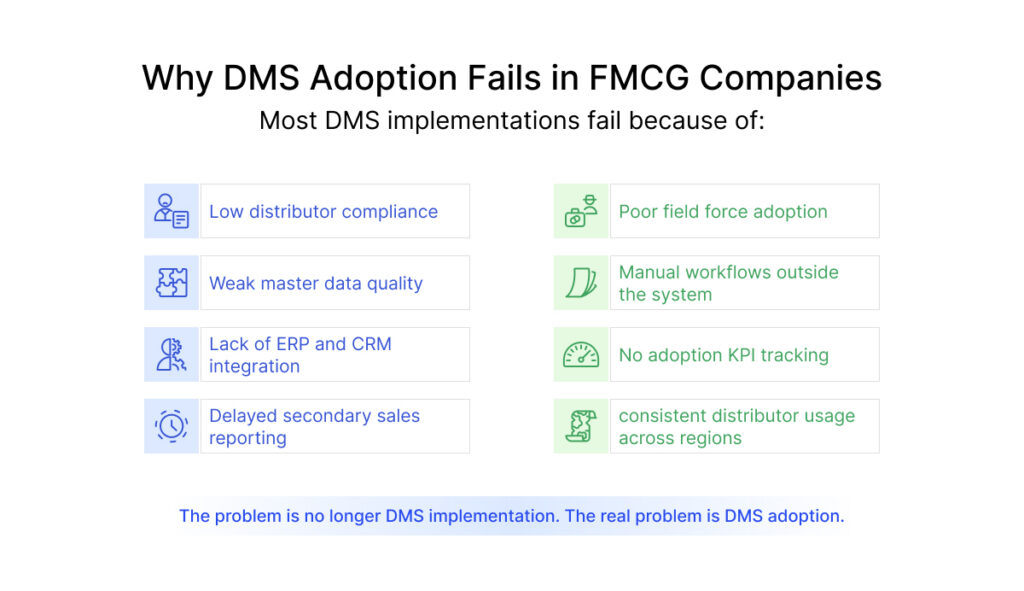
Over the years, FMCG and CPG companies have invested heavily in DMS software to improve secondary sales visibility, inventory tracking, distributor management, and retail execution. But many organisations still struggle with:
- Delayed secondary sales visibility
- Inventory visibility gaps
- Weak replenishment planning
- Low distributor compliance
- Manual order-taking processes
- Poor field-force usage
The problem is often not the software itself.
In many cases, distributors, sales teams, and managers never fully adopt the system in their daily operations. Without proper adoption, even the most advanced DMS becomes just another reporting tool filled with incomplete or delayed data.
This is the DMS adoption gap that directly impacts forecasting, inventory planning, stock availability, and overall route-to-market performance.
Table of Contents
What Does DMS Adoption Really Mean?
One of the biggest misconceptions in FMCG distribution is assuming implementation and adoption are the same thing. They are not. A DMS project usually moves through three stages:
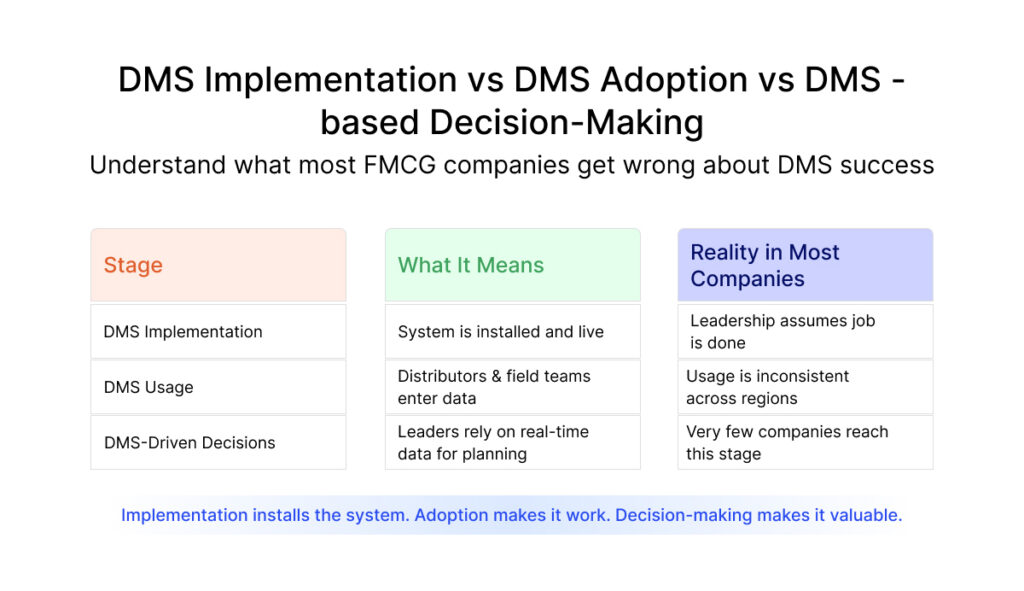
Implementation installs the system. Adoption makes it operational. Decision-making makes it valuable.
True DMS adoption happens when distributors regularly capture secondary sales, field reps use the system during market visits, and managers trust the data enough to make business decisions from it instead of depending on spreadsheets. That is where actual ROI begins.
The Distributor Management System Adoption Gap
Imagine a mid-sized FMCG company with hundreds of distributors across multiple regions. The company invests in a DMS expecting better visibility, smoother distributor operations, and stronger retail execution. Six months later, leadership reviews the dashboard expecting complete market visibility.
Instead, they discover:
- Distributors still sharing orders through WhatsApp
- Back-office teams manually entering sales data
- Sales reps maintaining parallel Excel sheets
- Delayed inventory updates
- Inconsistent reporting across territories
The company successfully implemented a DMS. But operationally, very little changed.
This is one of the biggest reasons many DMS implementations fail to deliver ROI. The issue is usually not the software itself. The real failure happens at the process, people, and adoption level.
Already Using a DMS but Still Not Seeing Results?
Many CPG companies already have a DMS running across distributors and field teams, but the expected business outcomes still fail to appear. In most cases, the issue is not the system itself but inconsistent operational usage.
- Delayed distributor data updates
- DMS used only for reporting
- Manual decision-making continues
- Poor master data quality
- Disconnected ERP, CRM, and SFA systems
Before replacing the DMS, companies should first identify operational gaps, improve data accuracy, strengthen field usage, and regularly track adoption KPIs. In many cases, small process improvements deliver better results than changing the entire platform.
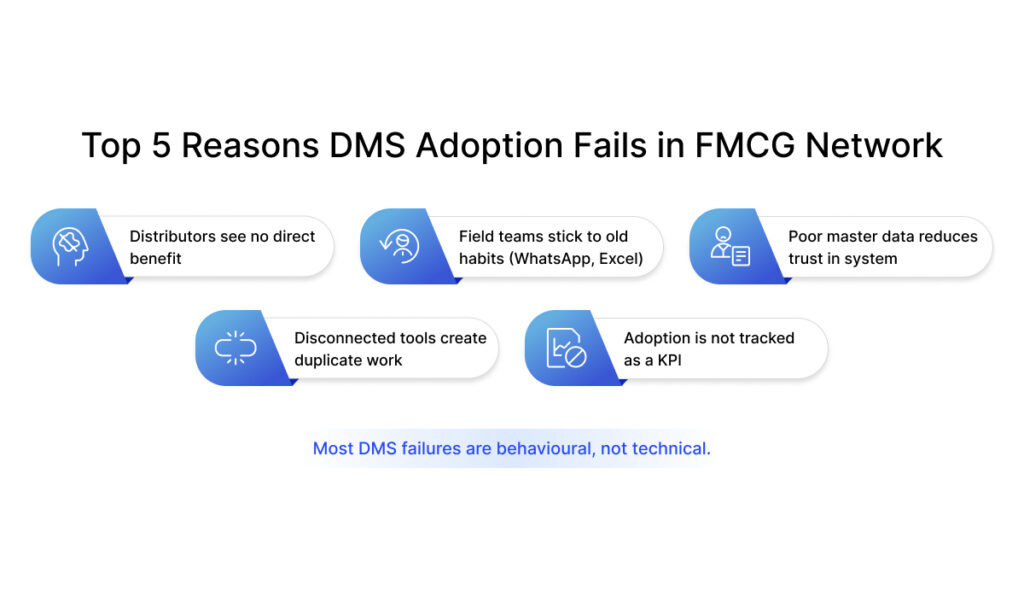
1. Distributors See the DMS as Extra Work
One major reason DMS adoption fails is distributor resistance. If distributors feel the DMS only increases their workload without adding business value, compliance drops quickly.
Common complaints include:
- Double data entry
- Complex interfaces
- Slow order processing
- Extra reporting work
Successful companies solve this by clearly showing distributors how the DMS benefits them through faster order processing, better stock visibility, and easier inventory planning. When distributors see operational value, adoption improves naturally.
2. Field Teams Continue Using Old Workflows
Many sales representatives still rely on:
- WhatsApp orders
- Excel sheets
- Phone calls
- Manual beat tracking
Why? Because those workflows feel faster and more familiar. Without proper onboarding and accountability, field teams return to old habits very quickly. This is why field adoption must begin before go-live. Sales teams should clearly understand:
- Why the DMS matters
- How it improves daily work
- What expectations exist during market visits
Hands-on training, beat-level accountability, and manager involvement are critical for improving long-term adoption.
3. Poor Master Data Creates Distrust
A DMS is only as reliable as the data inside it. Common issues include:
- Duplicate outlet entries
- Wrong SKU mappings
- Pricing mismatches
- Inventory inconsistencies
Once users stop trusting the data, they stop relying on the system.
That is why companies must standardise:
- SKU naming conventions
- Outlet codes
- Distributor IDs
- Territory mapping
- Pricing structures
Strong master data improves reporting accuracy, inventory visibility, and forecasting reliability.
4. Disconnected Systems Create Operational Problems
Many distribution-led businesses still operate disconnected ERP, CRM, SFA, and DMS platforms. When these systems fail to communicate properly, teams end up manually updating data across multiple tools. This creates:
- Reporting delays
- Data mismatches
- Duplicate work
- User frustration
Integrated systems improve operational visibility and reduce manual effort across the distribution network. Most importantly, they make the DMS easier to use consistently.
5. Companies Track Sales, Not Adoption
Most companies closely monitor revenue, market growth, and outlet coverage. But very few actively track DMS adoption metrics like:
- Distributor login frequency
- Order capture rates
- Data completeness
- Daily DMS usage
What leadership does not measure eventually gets ignored. Companies that regularly track adoption KPIs usually achieve stronger long-term DMS usage because issues are identified early.
What FMCG Companies Should Evaluate Before Investing in a DMS?
Before investing in a Distributor Management System, FMCG companies must evaluate whether their distributor network, processes, and field teams are ready for digital adoption. Many DMS projects fail not because of the software, but because operational readiness is ignored.
Key areas to evaluate include:
- Distributor digital readiness and operational discipline
- Existing order management and stock update processes
- Field team alignment and resistance to change
- Master data quality and workflow standardisation
- Integration readiness with ERP, CRM, and SFA systems
A DMS delivers results only when technology, processes, distributors, and field teams are aligned from the beginning.
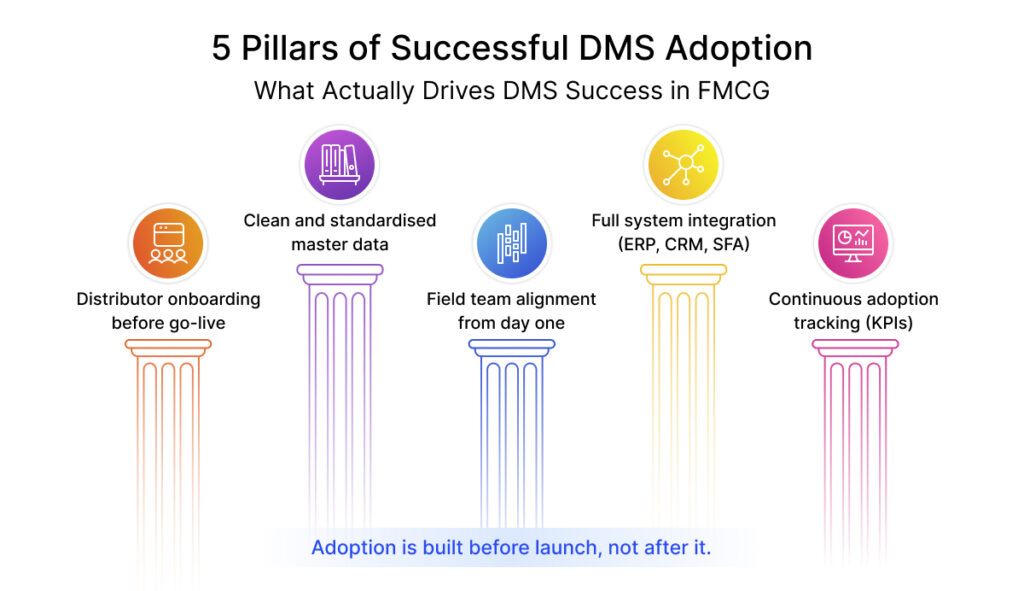
5 Critical Things Needed for Successful DMS Adoption
- Involve distributors early through onboarding and workflow training
- Standardise master data like SKU codes, outlet IDs, and pricing structures
- Prepare field teams before launch with practical training and accountability
- Integrate the DMS with ERP, CRM, and SFA systems to avoid duplicate work
- Track adoption KPIs regularly like login frequency, order capture, and data accuracy
Successful DMS adoption is not just about installing software. It is about building consistent operational usage across the entire distribution network.
What Changes After Successful DMS Adoption?
The operational difference becomes visible very quickly once adoption improves.
Before DMS Adoption | After DMS Adoption |
Delayed secondary sales reports | Near real-time visibility |
Manual distributor follow-ups | Faster operational visibility |
WhatsApp-based order-taking | Structured digital order capture |
Fragmented reporting | Unified dashboards |
Reactive stock planning | Predictive replenishment |
Low distributor accountability | Standardised execution |
The shift becomes visible across inventory planning, reporting accuracy, and retail execution. Instead of reacting to issues late, companies start identifying problems early and responding faster.
How to Ensure Successful DMS Adoption
Implementing a DMS is only the first step. Long-term success depends on how consistently distributors, field teams, and managers use the system in daily operations. Companies that focus on onboarding, process alignment, and continuous monitoring usually achieve stronger DMS adoption and better operational results.
1. Use a Phased Rollout
Start with a smaller region or distributor group before expanding across markets. This helps identify operational gaps early and reduces disruption during implementation.
2. Build Strong Distributor Onboarding
Continuous training, workflow guidance, and support help distributors comfortably use the DMS in their daily operations.
3. Combine Training with Incentives
Faster approvals, better scheme visibility, and operational benefits encourage stronger and more consistent DMS usage.
4. Continuously Monitor Adoption
Regularly track user activity, data quality, and workflow compliance to identify adoption gaps early and improve overall operational efficiency.
How Intelligent Systems Are Changing DMS Adoption
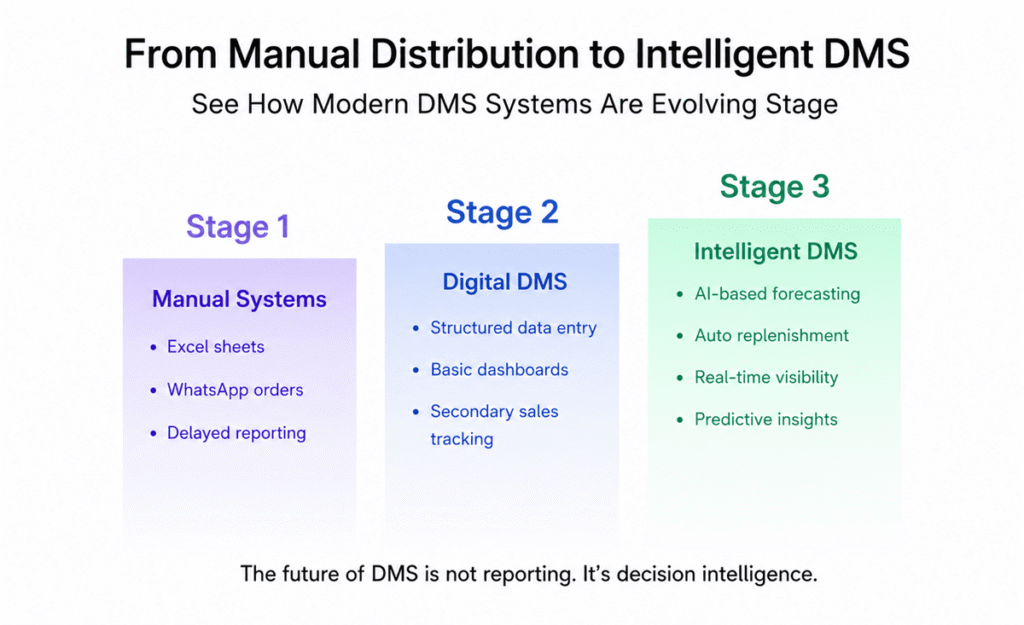
Traditional DMS platforms were mainly designed to capture transactions and generate reports. But modern CPG/FMCG distribution networks need systems that actively help teams make decisions.
Modern DMS platforms are increasingly using AI-driven forecasting and automation to:
- Predict demand patterns
- Recommend replenishment quantities
- Identify stock-out risks
- Improve forecasting accuracy
- Reduce manual stock planning effort
This changes how distributors and field teams view the system. When the DMS only asks users to upload data, adoption feels like extra work. But when the system helps distributors improve inventory planning and avoid stock-outs, the value becomes immediately visible. That is when real DMS adoption starts happening.
System Adoption Is the Real ROI Driver
Most FMCG/CPG companies spend months planning DMS implementation. Go-live day becomes a major milestone, dashboards start showing data, and leadership celebrates deployment success.
But the real test begins later. Weeks and months after launch, distributor engagement starts dropping, field teams slowly return to old habits, and operational discipline becomes the deciding factor.
Because implementation alone does not improve distribution performance. Adoption does.
A Distributor Management System only delivers measurable ROI when:
- Distributors actively use it every day
- Field teams depend on it during execution
- Leadership tracks adoption metrics regularly
- Data remains accurate and standardised
- Decision-making shifts from spreadsheets to live operational visibility
The companies getting the highest ROI from their DMS are not just focusing on technology. They are equally focused on distributor onboarding, field-team alignment, data governance, and operational accountability.
Because in the end, an implemented DMS gives visibility. A fully operationally adopted DMS changes business outcomes.