
A regional sales manager opens his system on a Monday morning. His Distributor Management System (DMS) dashboard shows 47 distributors across three states. Sales data, beat-wise secondary sales, and stock reports have been uploaded over the weekend.
On paper, everything looks fine.
But before 10 AM, his phone starts ringing.
A distributor in Maharashtra has run out of the bestselling shampoo SKU just before a weekend promotion. In Gujarat, another is sitting on three months of overstock nearing expiry. In Tamil Nadu, a distributor has not placed an order in eight days because the sales executive forgot to follow up.
The system shows data, but nothing prevents these problems.
This is the paradox of modern FMCG/CPG distribution. Companies invest in a DMS expecting better control, but visibility alone does not drive action. Stock data without response is just a well-designed spreadsheet.
The missing layer is clear: an Auto Replenishment System (ARS) inside the DMS.
The Core Problem in FMCG/CPG Distribution
The challenge in FMCG/CPG distribution is not collecting data, but acting on it at the right time. In many distribution networks, replenishment decisions still rely heavily on manual estimates, distributor judgment, and constant follow-ups. This often leads to:
- Fast-moving products go out of stock
- Slow-moving products accumulate
- Inventory becomes uneven across regions
- Working capital gets blocked in excess stock
McKinsey & Company estimates that better stockout management alone can unlock up to 5 percent revenue growth. Yet many companies still rely on reactive ordering systems.
Table of Contents
What Is an Auto Replenishment System (ARS) in a DMS?
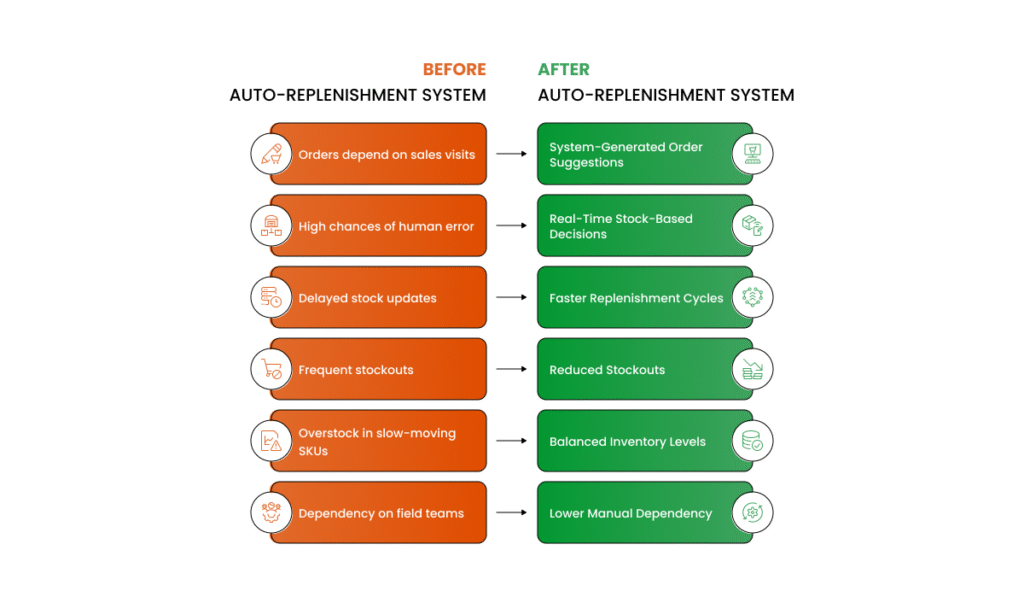
An Auto Replenishment System is a capability within a DMS that automatically calculates what to order, when to order, and how much to order based on real-time stock and sales data. Instead of waiting for human intervention, the system generates replenishment decisions using defined rules and live data.
In simple terms:
A DMS tells you what happened. An ARS tells you what should happen next.
It connects sales movement, stock availability, and business rules to ensure stock reaches distributors at the right time without manual dependency.
Why Can FMCG & CPG Businesses No Longer Rely Only on Manual Replenishment
Manual replenishment is no longer sufficient for FMCG and CPG businesses due to increased scale, SKU complexity, and dynamic demand patterns. These factors result in inefficiencies that require automated, system-driven replenishment.
Challenge in FMCG Distribution | What It Means in Reality | What Goes Wrong with Manual Replenishment |
Too many SKUs | Brands manage hundreds to thousands of products at once | Sales teams can’t track or replenish all products accurately |
Large distribution network | Thousands of distributors across regions | Orders become inconsistent and depend on who follows up |
Fast-changing demand | Sales fluctuate due to seasons, weather, and market trends | Decisions are delayed, leading to stockouts or excess stock |
Human dependency | Sales people drive ordering decisions | Bias, missed visits, and calculation errors impact accuracy |
Complex schemes & promotions | Discounts and offers change frequently | Incorrect order quantities and missed scheme benefits |
Working capital pressure | Distributors need to balance stock and cash | Overstock blocks cash, stockouts lead to lost sales |
How an Automated Replenishment System Works
ARS functions as a decision engine inside the DMS. It continuously evaluates stock and sales data, applies business rules, and triggers replenishment actions.
Data Inputs That Power ARS
The accuracy of an Auto Replenishment System (ARS) depends on the quality of input data. If inputs are weak or incomplete, replenishment decisions become unreliable.
A well-configured ARS in a Distributor Management System (DMS) uses:
- Distributor-wise PDP (Plan Delivery Period): Defines when each distributor receives stock and triggers order generation accordingly.
- Stock levels: Tracks current inventory at distributor level to identify replenishment needs.
- Stock norms (minimum, maximum, tolerance limits): Defines ideal inventory ranges to maintain balance and avoid stockouts or overstock.
- Product-wise MOQ (Minimum Order Quantity): Ensures orders meet minimum supply requirements.
- Division-wise product mapping: Organizes SKUs into categories for structured replenishment planning.
- Distributor credit settings: Sets credit limits and allows tracking of available balance for ordering.
The system continuously compares actual stock with expected thresholds. When stock falls below defined norms, replenishment is triggered automatically or recommended.
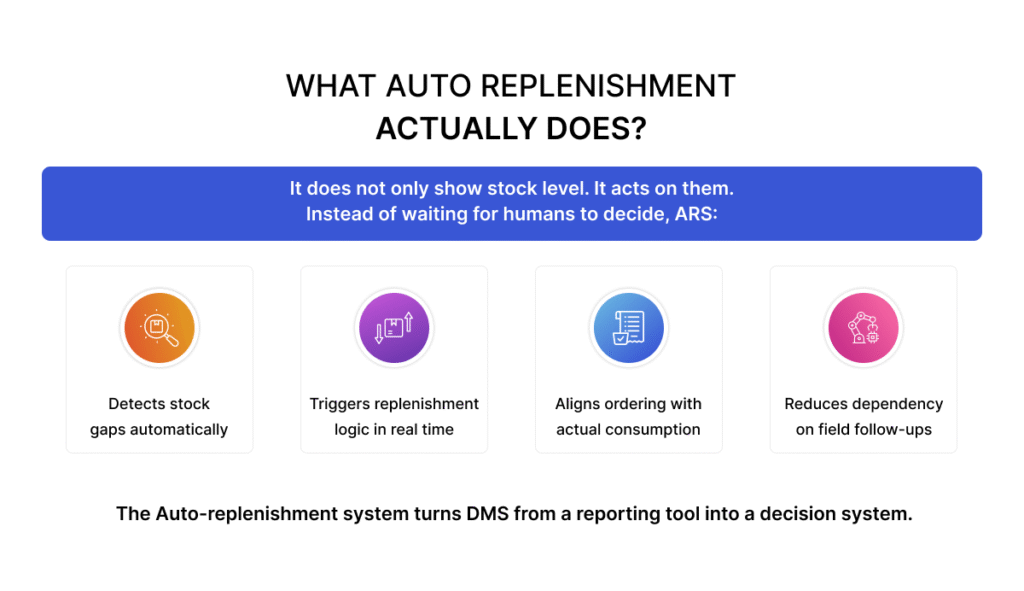
What Are the Key Business Benefits of Auto Replenishment in FMCG/CPG Distribution?
The impact of ARS extends beyond automation.
Reduced stockouts
Continuous monitoring ensures fast-moving SKUs are replenished before they run out.
Better inventory balance
Prevents both overstocking and understocking by maintaining defined stock norms.
Faster replenishment cycles
Removes dependency on manual follow-ups and approvals.
Improved sales productivity
Field teams spend less time on routine ordering and more on market expansion.
Better scheme execution
Ensures promotional demand is correctly factored into replenishment planning.
Research from McKinsey & Company also shows that AI-enabled supply chain systems improve service levels while reducing inefficiencies, reinforcing the value of automation in distribution planning.
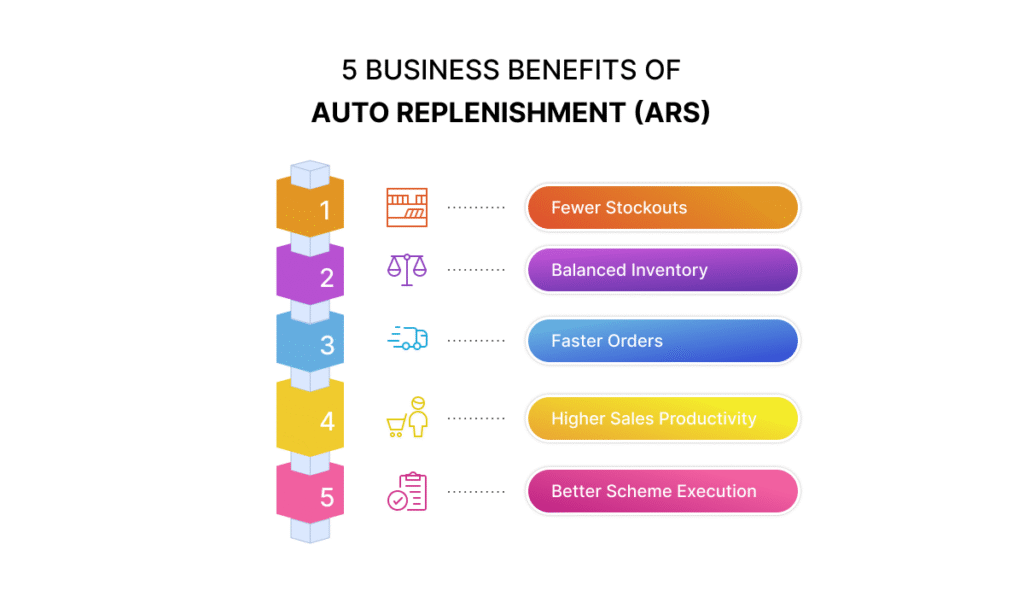
What Changes Before and After Implementing an Auto Replenishment System?
The difference between manual replenishment and an Auto Replenishment System (ARS) is most visible in day-to-day operations.
In manual setups, orders depend on sales follow-ups, distributor judgment, and delayed updates. With ARS, replenishment becomes system-driven, faster, and more consistent across the network, improving overall stock accuracy and responsiveness.
Area | Before ARS | After ARS |
Order creation | Depends on visits and manual judgment | Automatically generated based on rules |
Stock visibility | Delayed updates | Near real-time visibility |
Replenishment approach | Reactive | Proactive |
Sales team role | Heavy involvement in routine ordering | Focus on strategic tasks |
Inventory position | Uneven across distributors | Balanced and optimized |
The shift is not just automation, but a move from judgment-based ordering to data-driven execution.
How Do AI and Predictive Analytics Improve Auto Replenishment?
Basic ARS relies on fixed rules. Advanced systems use AI and predictive analytics to improve accuracy.
AI helps by:
- Detecting early demand shifts
- Adjusting for seasonal and regional patterns
- Forecasting promotional spikes
- Learning from past stockouts and overstock events
This shifts replenishment from reactive to predictive. Instead of responding to shortages, the system anticipates them.
Why Some Existing ARS Implementations Still Underperform
Many FMCG and CPG businesses already have an ARS in place but still face stockouts, excess inventory, and inconsistent ordering. In most cases, the issue is not automation itself, but poor configuration, weak data quality, or outdated replenishment logic.
Common signs of an underperforming ARS include:
- Frequent stockouts despite automated replenishment
- Excess stock in slow-moving SKUs
- Distributors overriding system-generated orders
- Heavy manual intervention even after automation
Businesses should regularly evaluate whether their ARS is improving stock availability, inventory movement, and replenishment accuracy instead of assuming automation alone guarantees results.
When Should Businesses Upgrade Their Existing ARS or DMS?
As distribution networks grow, basic replenishment systems often struggle to handle increasing SKU complexity and changing demand patterns.
Businesses should consider upgrading when:
- Stockouts continue despite automation
- Replenishment requires constant manual corrections
- The system cannot flag the schemes and promotions generated by the company
- Teams still rely on spreadsheets and manual follow-ups alongside the DMS
Modern ARS-based DMS platforms use real-time data, predictive analytics, and flexible replenishment logic to make inventory planning faster, smarter, and more scalable.
What Are the Biggest Challenges in Implementing ARS in a DMS?
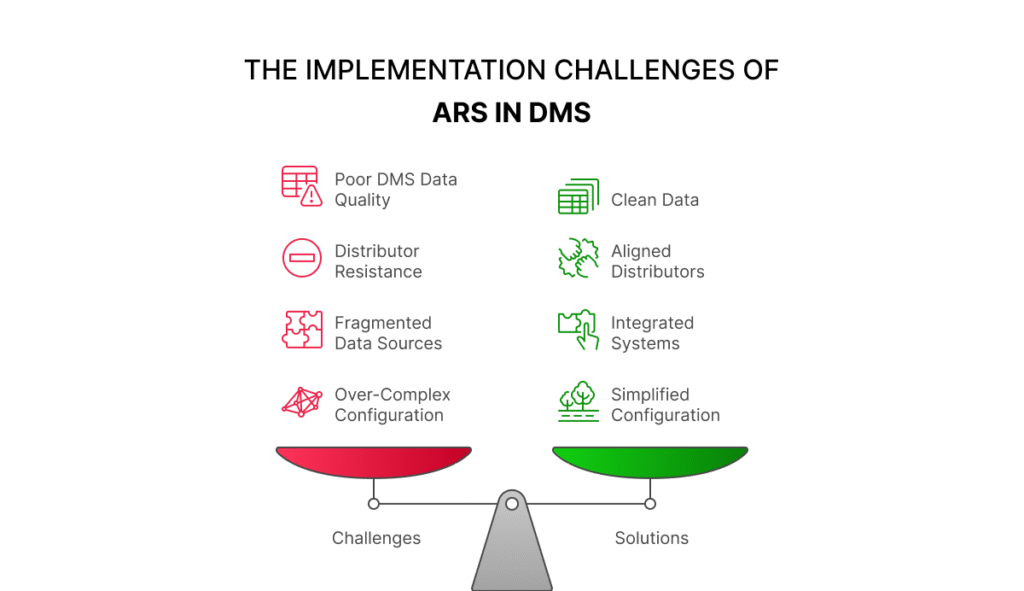
Implementing an ARS in DMS is not only about installing software. For ARS to work properly, businesses also need accurate data, proper processes, and strong DMS adoption. In many cases, operational issues create bigger challenges than the technology itself.
- Poor DMS adoption
If secondary sales or stock data is incomplete, the system cannot generate accurate replenishment decisions. - Distributor resistance
Some distributors may feel automated ordering reduces their control over purchasing decisions. - Fragmented data across systems
When sales, stock, and financial data are spread across multiple systems, replenishment accuracy gets affected. - Overly complex setup
ARS models that are too complicated become difficult for teams to manage and use effectively in day-to-day operations.
How Can You Successfully Implement Auto Replenishment in Your DMS?
Successful ARS implementation starts with strong operational discipline, not just technology. Here are some important steps:
1. Ensure Accurate DMS Data
Before enabling ARS, make sure distributors regularly update secondary sales and stock data. Poor data quality leads to inaccurate replenishment decisions.
2. Define Practical Stock Norms
Set realistic minimum and maximum stock levels based on sales trends, delivery timelines, and demand patterns to avoid overstocking or stockouts.
3. Configure Key Business Rules
Include rules such as MOQ, active schemes, promotions, and distributor credit limits so the system can generate more accurate replenishment orders.
4. Start with a Pilot Rollout
Test ARS in selected regions or distributors first. Compare system recommendations with actual ordering patterns before full-scale implementation.
5. Involve Distributors Early
Help distributors understand the benefits of ARS, including better stock availability, lower excess inventory, and improved stock movement.
6. Implement in Phases
Roll out ARS gradually across zones or channels to monitor performance, fix issues, and improve adoption more effectively.
7. Monitor and Optimise Continuously
Regularly review stock norms, replenishment accuracy, schemes, and distributor compliance to keep the system aligned with changing demand.
The goal is not to build a perfect system immediately. It is to make replenishment decisions more consistent, accurate, and scalable over time.
How Do You Evaluate a DMS with Auto Replenishment Capabilities?
Not all systems offer true automation. A strong ARS should:
- Integrate real-time sales and stock data
- Support schemes, promotions, and credit rules
- Provide transparent replenishment logic
- Adapt to different distributor structures
Avoid systems that rely heavily on manual overrides or lack visibility into decision-making.
What to Look for When Choosing an ARS Vendor
When selecting an ARS for your DMS, automation alone should not be the deciding factor. The system should also be flexible, scalable, and practical for real distribution operations.
A strong ARS should offer:
- Industry-specific customisation based on your distribution model and SKU movement
- Easy configuration of stock norms, replenishment rules, and business conditions
- A clear replenishment blueprint that can detect stockout risks early and trigger timely replenishment before a complete stockout happens
- Minimal dependency on vendors for day-to-day changes and adjustments
- Proven implementation experience across different industries with measurable business results
It is always better to choose value-driven vendors who have already delivered reliable outcomes such as improved stock availability, lower excess inventory, and better replenishment accuracy across distribution networks.
Distribution today is far more dynamic and demanding than it was a few years ago. More SKUs, faster demand shifts, and tighter margins mean that visibility alone is no longer enough. A DMS without ARS is only a reporting system. A DMS with a well-configured and intelligent ARS becomes a real decision system.
But simply having an ARS in place is not enough. Businesses also need to continuously evaluate whether their replenishment system is actually improving stock availability, inventory balance, and distributor efficiency. If automation still depends heavily on manual corrections, outdated rules, or reactive ordering, the system may no longer be supporting the scale and speed modern distribution requires.
The real shift is not just from manual replenishment to automation. It is from reactive decision-making to intelligent, predictive distribution planning.
Auto Replenishment does not replace human intelligence. It removes repetitive operational decision-making so teams can focus on growth, execution, and strategy.
The question is no longer whether businesses need ARS. It is whether their current replenishment system is advanced enough to keep up with modern distribution complexity.