
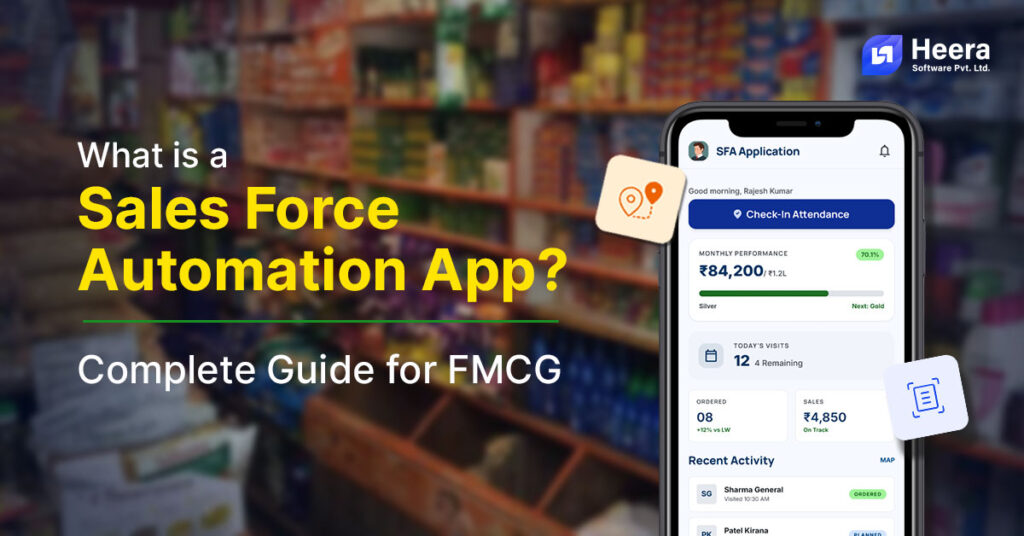
Most people think they understand what Sales Force Automation (SFA) is, but often confuse it with Field Force Automation (FFA) in the FMCG industry. Both may seem similar at first, so let’s start from the beginning and first understand what a Sales Force Automation app is.
A Sales Force Automation app is a mobile-based platform that captures and manages field sales activity in real time – it allows outlet visits, order booking, attendance capturing, & overall reporting – replacing manual processes with a structured digital system that gives decision makers and sales managers live visibility into everything happening across their territories.
But if that’s what it does, why do FMCG companies still struggle with sales productivity and full visibility into their ground execution?
If you searched for this, chances are you’re not just looking for a definition. You’re trying to understand what’s happening in your market. Are your sales representatives (reps) covering all retail outlets? Are orders being captured accurately? Is your team spending time selling, or just updating field reports at the end of the day?
Sales teams are on the ground every day, visiting outlets, taking orders, and pushing products into the market. But by the time this information reaches decision-makers, it’s often delayed, incomplete, and outdated. And in FMCG, that delay directly impacts the company’s revenue. This is exactly where a Sales Force Automation App for FMCG companies becomes more important. It doesn’t just digitise sales activity, it brings structure, speed, and real-time visibility into sales operations that are otherwise difficult to track at scale.
Most FMCG companies don’t struggle to sell. They struggle to see what’s happening while it’s happening. Studies from McKinsey & Company suggest that sales reps spend nearly 30-40% of their time on non-selling tasks like route-to-market reporting and retailer coordination.
In this guide, we break down Sales Force Automation (SFA) for FMCG businesses in a simple, practical way. You’ll learn what an SFA app is, how it works in real-world field operations, and how it manages route planning, scheme & promotion tracking, beat planning and more such sales & distribution operations in day-to-day field management. We also cover the difference betweenSales Force Automation (SFA) and Field Force Automation (FFA), common challenges without it, its integration with DMS, and what to consider when choosing the right solution.
If your role depends on knowing what’s happening in the market, not after the day ends, but while it’s happening, this guide will help you understand how to build that visibility.
What is a Sales Force Automation System?

A Sales Force Automation system is a digital tool that helps businesses capture, track, and manage field sales operations such as order booking, outlet visits, and reporting while managing compliance activities like merchandising and adding new outlets in a structured way.
It is typically used through an SFA mobile app, allowing sales representatives to record their daily activities directly from the field. Instead of relying on manual updates, all sales-related data is logged in one place, making it easier to track and review field operations consistently.
How Sales Force Automation Works in FMCG (Step-by-Step)
Sales force automation works by capturing field sales activities through an AI-powered SFA tool, syncing data to a central system, and providing the sales head with visibility into sales performance and outlet coverage. Here’s the step-by-step flow:
1) Day Starts in the App
Sales representatives log in to the field force tracking or Sales team tracking mobile applicationto mark attendance and view their assigned routes, outlet list, and daily tasks.
2) Outlet Visits Are Recorded
As they visit each outlet, they log the visit and update details such as orders placed, stock availability, and retailer inputs directly in the app.
3) Orders Are Captured on the Spot
Instead of noting orders manually, sales reps enter them into the system during the visit, along with applicable schemes and product details.
4) Data Syncs to the System
If the internet is available, the data is updated instantly. In areas with low internet connectivity, such as certain urban or rural markets, orders are stored on the offline Sales App and automatically synced once the connection is restored.
5) Information Appears in the Backend
Once synced, the data becomes available in the central system, where it is organized under sales activity, orders, and outlet-level records.
6) Managers Access Live Updates
Managers can view this information through dashboards that reflect field activity, order entries, and visit status as they are recorded.
7) End-of-Day Reporting
At the end of the day, sales reps submit a summary of all their completed tasks, ensuring accurate records for review and analysis.
8) Occasional Activities: Merchandising & New Outlet Creation
Sales reps also perform occasional activities such as merchandising checks and creating new outlets, which are recorded in the app whenever these tasks are completed.
Why FMCG Companies Need a Sales Force Automation System
FMCG companies need a top-rated sales force automation system because managing large-scale, fast-moving sales operations manually leads to inefficiencies, delays, and lost business revenue opportunities, resulting in slow company growth. With the complexity of CPG distribution, these challenges multiply, but the right SFA system tracks every activity, streamlines operations, and turns effort into consistent growth.
Most FMCG businesses deal with:
- High transaction volumes across multiple regions
- Large and fragmented distributor networks
- Thousands of retail outlets to service regularly
- Frequent sales cycles with changing demand patterns
A modern field sales app helps companies:
- Enable faster communication between sales reps, managers, and distributors
- Improve order accuracy and coordination across the supply chain
- Ensure consistent execution at the retail level
Sales force automation adoption in India is rapidly growing across industries like food & beverages, personal care, electronics, apparel, retail chains, industrial products, and chemicals sectors that are a perfect fit for SFA due to their need for structured field execution and real-time visibility.
Ground Realities of FMCG Sales in India
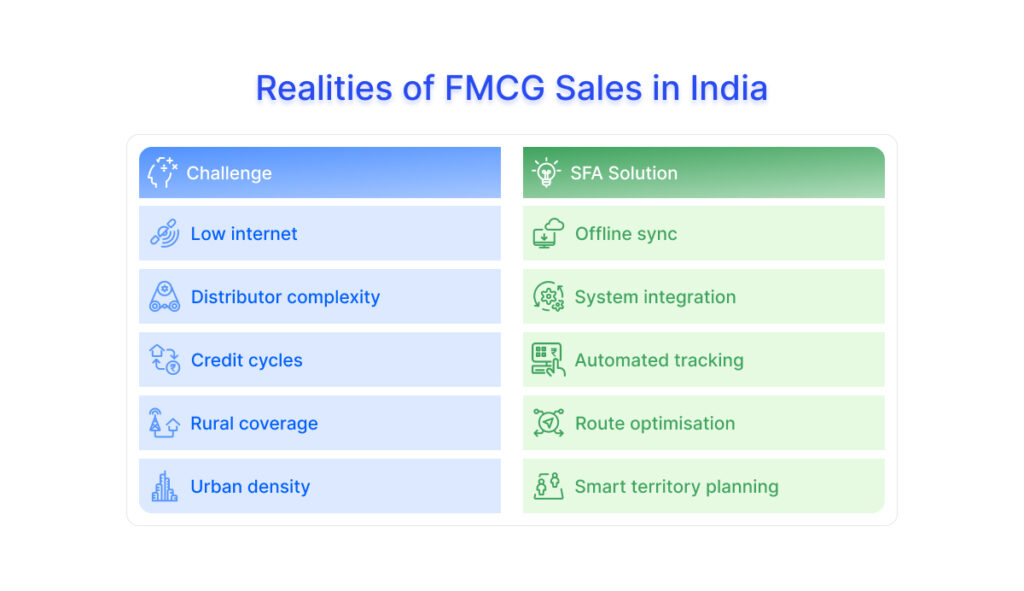
FMCG sales in India operate in conditions that are far from uniform. Any field sales management software needs to work within these realities, not around them.
i) Low or inconsistent internet connectivity makes offline functionality essential for field teams.
Solution: Field teams can capture orders and updates offline, which automatically sync when connectivity is restored.
ii) Distributor-led sales models require tight coordination between field sales and backend systems.
Solution: Integrated platforms ensure real-time communication and alignment between field operations and backend systems.
iii) Credit-based retail cycles add complexity to order management and payment tracking.
Solution: Automated tracking and alerts help monitor credit, manage approvals, and streamline payments.
iv) Rural and semi-urban coverage challenges make structured route planning critical.
Solution: Optimised route planning ensures maximum coverage and efficient use of field resources.
v) High outlet density in urban markets demands efficient time and territory management.
Solution: Smart territory management and visit prioritisation tools increase productivity and reduce wasted travel time.
For example, In remote villages, sales reps used to carry paper forms and later input them into the system. Orders were often delayed or misplaced. An offline-capable SFA app allows reps to record visits and orders directly in the field, syncing automatically when connectivity is available, so managers always have an up-to-date view.
These factors show that a one-size-fits-all approach to sales automation won’t work. The system must be designed to match the realities of FMCG sales on the ground, combining offline capability, route optimisation, and seamless coordination, especially when the future of sales automation in general trade continues to evolve.
Challenges in FMCG Without Sales Force Automation (And Their Impact)
Before advanced technology became widely available, FMCG companies relied on Excel sheets, WhatsApp messages, and manual order books to manage their sales operations. At first, this seemed sufficient – sales reps recorded orders on paper, managers compiled spreadsheets, and teams communicated over messaging apps.
But as businesses scaled, these methods quickly showed their limitations and a few recurring challenges started coming which includes:
1) Lack of Real-Time Visibility
Managers often rely on end-of-day or manual reports to understand what’s happening in the field. This leads to:
- Delayed insights
- Incomplete data
- Reactive decision-making
Impact:
Opportunities are missed because decisions are based on outdated information.
2) Manual Errors and Inaccurate Reporting
When sales data is recorded manually or across multiple tools, errors become inevitable. Common issues include: In many cases, a sales rep may forget to report an order, enter incorrect quantities, or apply the wrong scheme during billing. Sometimes, the same order gets recorded twice, leading to duplicate entries & confusion at the distributor level.
Impact:
Poor data quality leads to wrong decisions, affecting sales planning and forecasting.
3) Inefficient Route Planning and Outlet Coverage
Without structured route planning, sales reps may:
- Skip outlets
- Visit fewer stores than planned
- Spend more time travelling than selling
Impact:
Lower market coverage directly reduces potential sales.
4) Weak Distributor Coordination
In many FMCG setups, communication between sales teams and distributors is fragmented.
This results in:
- Delayed order processing
- Miscommunication on stock and pricing
- Order- Fulfilment delays
Impact:
Stockouts, lost sales, and strained distributor relationships.
5) Limited Sales Team Productivity
A significant portion of a sales rep’s time goes into:
- Manual reporting
- Coordination calls
- Administrative tasks
Impact:
Less time spent selling, which directly affects revenue generation.
6) Poor Performance Tracking
Without a centralised sales force automation solution, it becomes difficult to track:
- Individual sales performance
- Outlet-level activity
- Territory-wise productivity
Impact:
The sales head lacks clarity on what’s working and what needs improvement.
The Bigger Picture
Individually, these challenges may seem manageable. But together, they create:
- Revenue leakage
- Inefficient operations
- Poor execution at the last mile
This is why many FMCG companies eventually reach a point where manual systems stop working.
Without SFA vs With SFA (Before vs After Implementation)
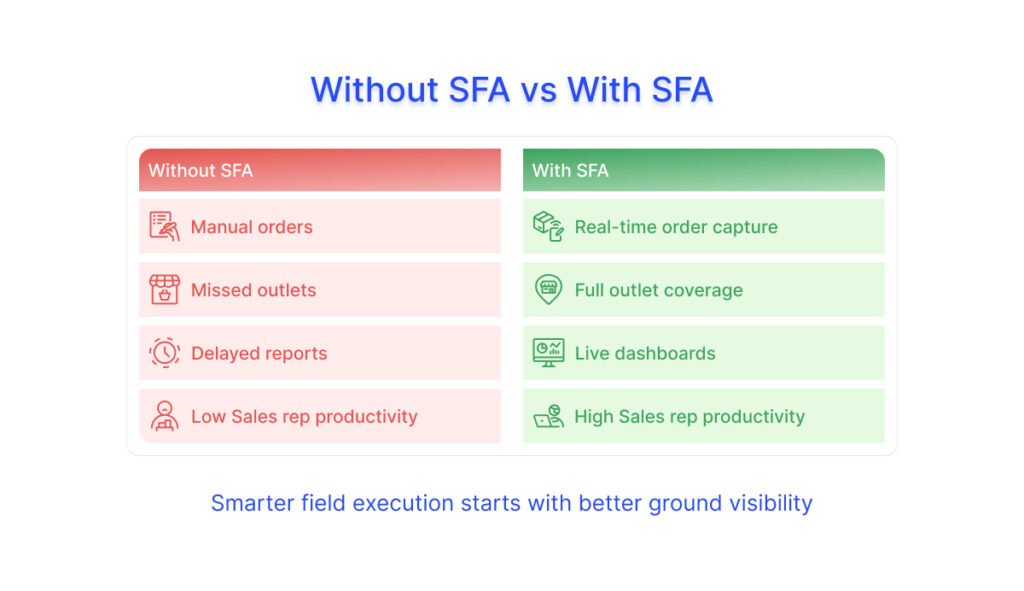
Seeing the impact of SFA in real-world FMCG operations is easiest when you compare how things worked before and how they improve after implementing an SFA system:
Aspect | Without SFA | With SFA |
Order Capture | Orders recorded manually on paper or Excel; prone to mistakes, duplicates, and delays | Orders captured instantly in the app, with schemes and product details applied correctly |
Outlet Coverage | Reps may miss stores or visit fewer outlets than planned | Automated beat planning ensures maximum coverage and optimized routes |
Field Visibility | Managers rely on end-of-day reports or WhatsApp messages | Real-time dashboards show live visits, orders, and performance |
Distributor Coordination | Fragmented communication; delays in stock updates and fulfillment | Integrated with DMS, enabling smooth order flow, inventory checks, and faster delivery |
Sales Team Productivity | Time spent on manual reporting, coordination, and messaging | Reps focus on selling; administrative tasks are automated |
Performance Tracking | Hard to monitor individual reps, territory efficiency, or KPI progress | Track reps, outlets, orders, and KPIs consistently; data-driven insights for managers |
Data Accuracy | High risk of errors in quantities, schemes, or duplicate entries | Data validated at entry, synced instantly, and stored centrally |
Decision Making | Reactive; based on delayed or incomplete information | Proactive; managers can act while the market is still moving |
Takeaway: The difference is dramatic. With SFA, sales operations move from fragmented, error-prone processes to structured, real-time, and insight-driven execution– turning field effort directly into measurable growth.
Top Benefits of Sales Force Automation for FMCG Companies
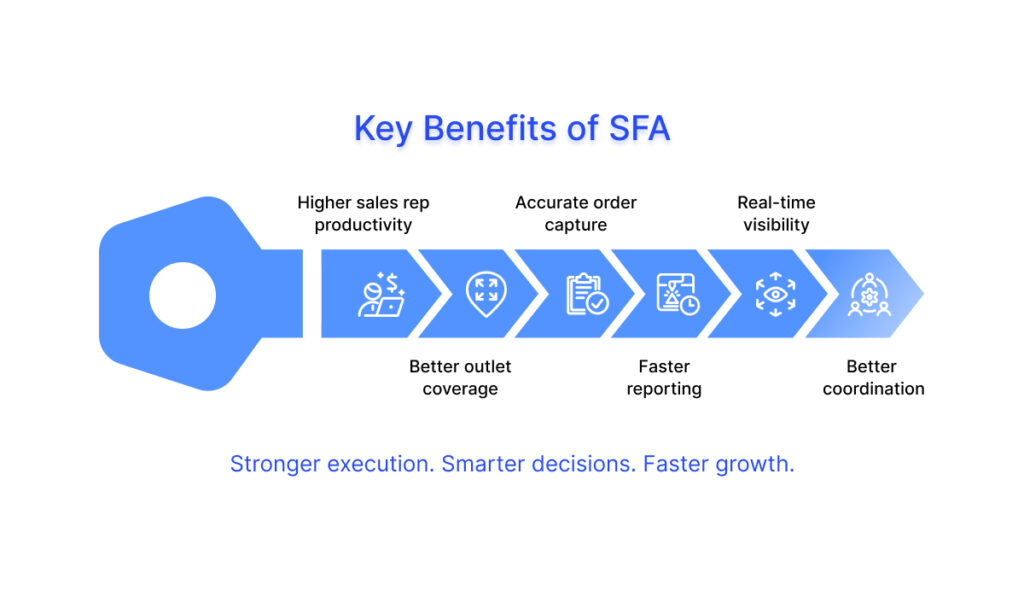
Sales force automation for FMCG companies helps improve field sales productivity, ensure better outlet coverage, enable accurate order capture, and provide real-time visibility into sales operations. It allows businesses to manage on-ground execution more efficiently and respond faster to market changes.
Key benefits include:
- Improved field sales productivity
- Better outlet coverage
- Accurate order capture
- Faster reporting
- Real-time sales visibility
Once a sales force automation system is in place, these benefits become visible in how sales operations are managed and executed on the ground. Instead of delayed updates and manual coordination, teams start working with structured, near-real-time information that reflects actual market conditions.
Key Sales KPIs You Can Track with a Field Sales Management Software
A field sales management software doesn’t just track activities; it helps you measure performance in a structured and consistent way. For FMCG businesses, these metrics are essential to understand what’s working in the market and where improvements are needed. Some of the most important KPIs include:
- Outlet Coverage (%)
Measures how many planned outlets are visited by the sales team. Low coverage often indicates gaps in execution.
- Strike Rate
The percentage of outlet visits that result in an order. This helps assess how effective sales reps are at converting visits into sales.
- Average Order Value (AOV)
Tracks the average value of each order placed. A higher AOV indicates better selling and product mix.
- Lines per Bill
Measures how many SKUs are sold per order. This reflects cross-selling and product penetration.
- Sales per Representative
Evaluates the overall productivity of each sales rep based on total sales generated.
- Order Frequency / Repeat Orders
Indicates how often retailers are placing orders, helping track demand consistency.
Sales Force Automation vs Field Force Automation: Key Differences Explained
The terms Sales Force Automation (SFA) and Field Force Automation (FFA) are often used interchangeably, but they serve different purposes in field operations. In simple terms:
- Sales Force Automation (SFA) is used to manage sales-specific activities such as order booking, customer interactions, pricing, and sales tracking.
- Field Force Automation (FFA) is used to manage broader field operations, including attendance tracking, task assignments, merchandising checks, and activity monitoring.
Key Differences Between SFA and FFA
Here’s a side-by-side comparison to make the distinction clearer:
Sales Force Automation (SFA) | Field Force Automation (FFA) |
Sales-focused system | Operations-focused system |
Drives revenue and sales performance | Manages field workforce and activities |
Order booking and revenue tracking | Attendance and task tracking |
Customer and retailer interactions | Activity monitoring and compliance |
Retail sales execution | Field workforce management |
Sales insights and analytics | Workforce visibility and control |
In modern systems, SFA and FFA capabilities often overlap within a single platform.
Sales Force Automation vs CRM vs DMS
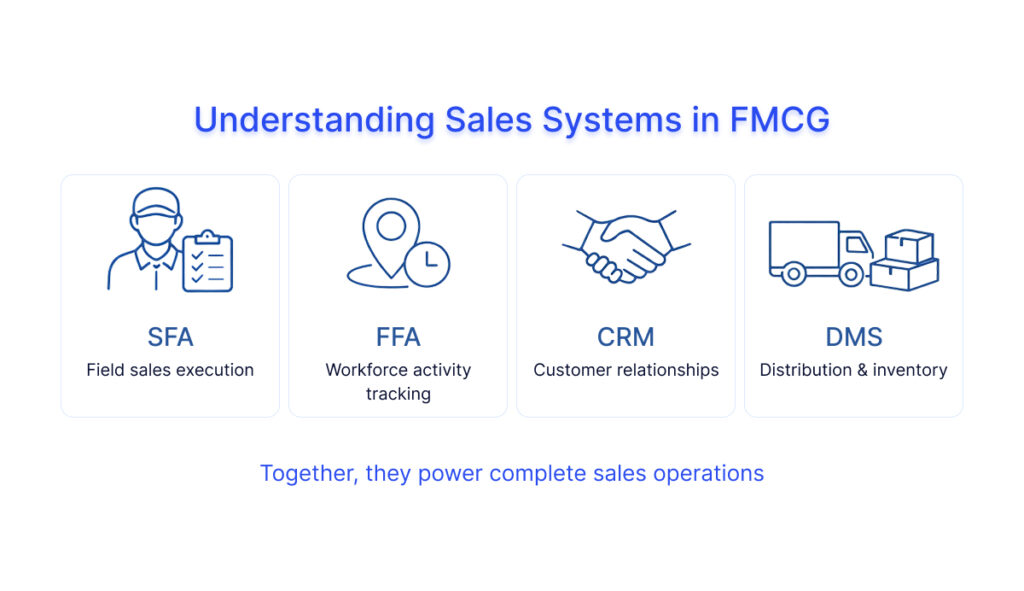
Sales Force Automation (SFA), Customer Relationship Management (CRM), and Distributor Management System (DMS) are often used together in FMCG businesses, but they serve very different purposes.
In simple terms, each system handles a different part of the sales process.
- SFA manages what happens in the field
- CRM manages customer relationships and interactions
- DMS manages distributor operations and order fulfilment
Aspect | Sales Force Automation (SFA) | CRM | DMS |
Primary Focus | Field sales execution | Customer relationship management | Distributor operations |
Used By | Sales reps, field managers | Sales & marketing teams | Distributors, backend teams |
Core Function | Track visits, capture orders, monitor field activity | Manage customer data, interactions, and communication | Process orders, manage inventory, billing, and dispatch |
Data Type | Real-time field activity | Customer history and engagement | Inventory, orders, and billing data |
Role in FMCG | Drives on-ground sales execution | Builds long-term customer relationships | Ensures smooth supply and fulfillment |
How They Work Together in FMCG
In a typical FMCG setup, these systems are connected to ensure smooth operations:
- A sales rep captures an order using the SFA app during an outlet visit
- The order flows into the DMS, where inventory is checked, billing is processed, and dispatch is initiated
- Customer and retailer information can be synced with the CRM for better relationship management and tracking
This connected flow ensures that what happens in the field is directly linked to backend execution and customer data.
Why This Difference Matters:
Understanding the difference helps businesses avoid a common mistake, expecting one system to do everything.
- SFA improves field execution and visibility
- CRM improves customer relationships and engagement
- DMS ensures order processing and supply chain efficiency
Together, they create a complete and connected sales ecosystem for FMCG businesses.
Top 10 Key Features of Modern Sales Force Automation System
The effectiveness of a field sales management app depends on the features that support everyday field execution. If you’re evaluating a sales force automation software for FMCG, here are the features that truly matter.
1) Mobile App with Offline Capability
Sales representatives use the SFA mobile app to log attendance, access assigned routes, record outlet visits, and capture orders. The app continues to function without internet access and syncs data once connectivity is available.
2) Real-Time Activity Tracking
Managers can view sales rep locations, outlet visits, and all the order entries recorded by salesperson, without waiting for manual updates or reports.
3) Beat Planning Software Intelligence
The system assigns daily routes and outlet lists while also optimising beat plans based on territory, outlet priority, and past performance. This ensures coverage optimisation and more efficient field movement.
4) Digital Order Capture with Scheme Management
Sales reps enter orders directly into the system during outlet visits, including product selection, quantities, and applicable trade schemes. This reduces errors and ensures schemes are applied consistently.
5) Inventory Visibility and Secondary Sales Tracking
When integrated with DMS or backend systems, it provides visibility into distributor-level stock and tracks secondary sales movement, helping teams understand what is selling at the retail level.
6) Retail Execution and In-Store Visibility
Sales reps can capture merchandising details such as product placement, planogram compliance, and shelf visibility, ensuring execution standards are maintained across outlets. Modern platforms also support retail execution, ensuring stores are merchandised correctly and sales opportunities are maximised. Key capabilities include:
- Shelf visibility: Track product placement and display across stores.
- Competitor tracking: Monitor competitor promotions and shelf presence.
- Planogram compliance: Ensure products are arranged according to merchandising standards.
- Stock audits: Verify inventory levels and availability in real time.
To understand how leading brands improve in-store performance, read our blog on FMCG retail execution best practices: https://heerasoftware.com/fmcg-retail-execution-best-practices-for-business/
7) Reporting and Dashboards
Sales activity, order data, and outlet-level information are organised into dashboards that decision makers, including CEO and the IT Head, can access for review and tracking.
8) Custom Workflows
Approval processes, reporting formats, and activity flows can be configured to match the company’s existing sales structure and processes.
9) Integration with DMS and ERP Systems
Orders captured in the field are passed into distributor and backend systems for further processing, including billing, inventory checks, and dispatch.
10) Data Security Controls
Access to data is managed through user roles, and system activity is tracked to maintain control over sensitive business information.
When selecting a sales force automation solution, it’s important to focus on impact rather than just features. If your sales force automation application can deliver on such outcomes, it becomes a key driver of sales performance and business growth.
Types of Sales Force Automation Software for FMCG Businesses
Not all Sales Force Automation (SFA) platforms are built the same. They differ based on how sales teams operate and what the business needs. Understanding these types helps FMCG and other field-driven businesses choose the right solution for their sales operations which are built for real distribution challenges. Types of SFA Platforms include:
1) Operational SFA (Field Execution Focus)
Focuses on day-to-day sales activities in the field, such as tracking outlet visits, capturing orders, managing routes, and logging attendance.
What it does:
- Tracks sales visits and outlet coverage
- Captures orders in real time
- Supports beat planning and route management
- Monitors attendance and GPS tracking
Used by: FMCG, food & beverage, and pharma companies.
2) Analytical SFA (Data & Insights Driven)
Converts sales data into insights through dashboards, KPI tracking, and forecasting, helping IT Head make informed decisions.
What it does:
- Generates sales reports and dashboards
- Tracks KPIs and team performance
- Supports forecasting and trend analysis
Used by: Mid to large enterprises, sales heads, and management teams
3) Collaborative SFA (Communication Focus)
Enables smooth communication and coordination between teams, distributors, and managers to reduce delays and improve alignment.
What it does:
- Enables internal communication and coordination
- Facilitates distributor and partner collaboration
- Manages tasks and assignments
Used by: Companies with large, distributed sales teams or multi-region operations
4) Mobile SFA (For On-the-Go Sales Teams)
Provides a mobile app for sales reps to record visits, orders, and merchandising activities, working offline and syncing data when connectivity is available.
What it does:
- Provides a mobile app for sales reps
- Allows offline order booking with automatic sync
- Includes geo-tagging and real-time updates
Used by: Almost every field sales-driven company
5) CRM-Integrated SFA
Combines sales execution with customer relationship management, tracking leads, opportunities, and customer interactions alongside field activity.
What it does:
- Tracks leads and opportunities
- Maintains customer interaction history
- Provides pipeline visibility and reporting
Used by: B2B companies, SaaS providers, manufacturing, and real estate
6) Industry-Specific SFA
Tailored to sector-specific needs, like FMCG distributor management, pharma doctor call tracking, or retail merchandising audits.
Tailored for specific sectors
Examples:
- Pharma SFA → Doctor call tracking
- FMCG SFA → Distributor and retailer management
- Retail SFA → Merchandising audits
7) AI-Powered / Smart SFA (Next-Gen Systems)
Uses artificial intelligence to predict demand, optimise routes, and provide recommendations, enabling faster, data-driven decisions.
What it does:
- Provides sales predictions and demand forecasting
- Optimizes routes and coverage
- Offers smart recommendations for reps
Used by: Large and medium enterprises and businesses investing in AI-driven field operations.
How to Implement Sales Force Automation in FMCG Companies
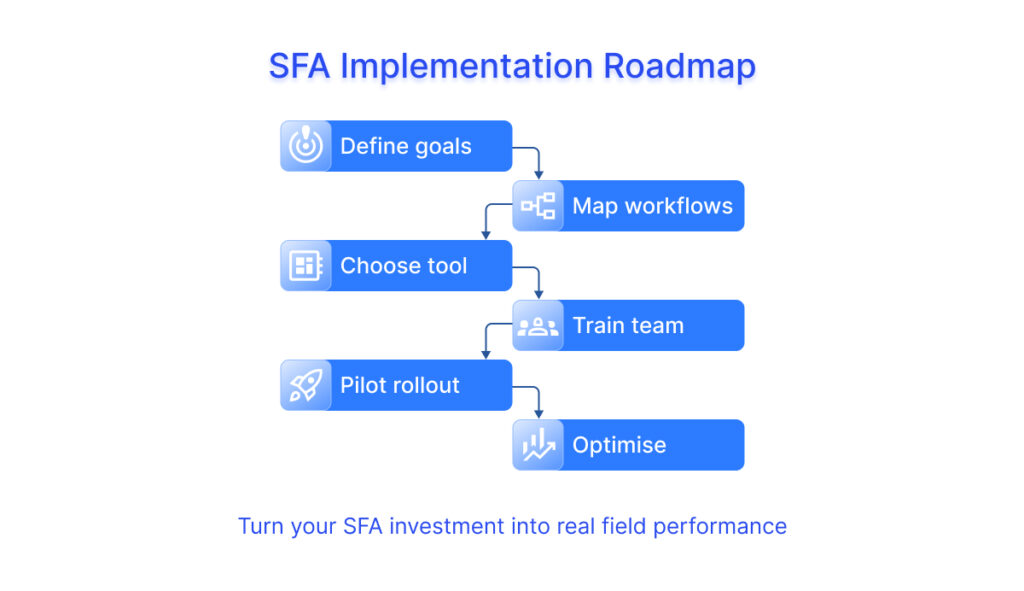
Implementing a field sales platformis not just about choosing the right tool. It’s about ensuring that the system is adopted effectively across your sales team. A structured approach makes all the difference.
Step-by-Step Implementation Approach
- Define clear business objectives and expected outcomes
- Map your existing sales and distribution workflows
- Choose the right field sales management app based on your needs
- Train your sales team for smooth adoption
- Start with a pilot rollout in a specific region or team
- Optimize the system based on feedback and real usage
The focus should not just be on features, but on usability and adoption.
Because even the best order management system for FMCG delivers value only when your team actively uses it in the field.
Common Mistakes to Avoid When Implementing Sales Force Automation: A Complete Checklist
Even the most advanced SFA software can fail if it is not implemented correctly. Adoption is often the biggest challenge, not the technology itself.
Here are the most common mistakes businesses should avoid:
- Choosing overly complex tools that are difficult for field teams to use daily
- Ignoring user training, which leads to low adoption and inconsistent data entry
- Not defining clear KPIs, making it difficult to measure success or ROI
- Poor data migration, resulting in inaccurate or incomplete information
- Lack of leadership involvement, which reduces accountability and slows adoption
A successful SFA system is not just about features and cost effectiveness. It’s about how effectively it is used by your sales team in real-world conditions.
Best Sales Force Automation Tools with CRM Integration for FMCG Businesses in India
Many businesses today prefer a field sales management app that integrates with CRM capabilities. This allows companies to manage both sales activities and customer relationships in a single platform. With CRM integration, teams can track retailer and distributor interactions, maintain complete customer histories, and align sales data with overall customer engagement- creating a more connected and efficient sales process.
Choosing the right secondary sales tracking system is critical for FMCG businesses in India, especially in distribution-driven industries. The best solutions are those your sales team can use easily and consistently in the field. Key qualities to look for include:
- Ease of Deployment: Quick to set up and simple to learn.
- Mobile-First Design with Offline Capabilities: Supports field teams even in low-connectivity areas.
- Scalability: Grows seamlessly as your sales team and distribution network expand.
The right system delivers value from day one without slowing down your team. It’s not about picking a popular brand it’s about selecting a solution that improves field execution, aligns with business needs, and supports long-term growth. For FMCG companies in India, usability, scalability, and real-world impact should always guide the decision.
Sales Force Automation Pricing in India: Cost & Factors Explained
When you compare pricing for popular sales force automation platforms, it varies widely depending on features, customisation, and scale.
For businesses, most solutions follow a subscription-based model, usually priced per user.
In general:
- Basic plans include core features like order booking, reporting, and activity tracking
- Mid-tier plans might offer analytics, integrations, and workflow automation
- Advanced plans may include full integration with CRM and ERP systems, along with deeper insights
For most FMCG companies, a cloud-based sales force automation platform provides the best balance between affordability and functionality.
Data Security in Sales Force Automation Software: What FMCG Companies Must Know
SFA systems store sensitive business information & protecting this data is critical. This typically includes:
- Distributor pricing, margins, and trade schemes
- Retailer sales and order data
- Outlet locations and visit history
- Credit, billing, and payment information
Because this data directly impacts operations and competitiveness, any breach can lead to serious risks such as loss of market advantage, channel conflicts, and damaged distributor relationships.
That’s why choosing a secure sales force automation software in India is essential. A reliable system should offer:
- Role-based access control
- Data encryption (in transit and at rest)
- Secure cloud infrastructure
- Mobile device security
- Audit trails and activity tracking
- Data backup and recovery
A well-secured SFA solution not only protects sensitive data but also builds trust and ensures your business can scale safely.
Latest Trends in Sales Force Automation in India
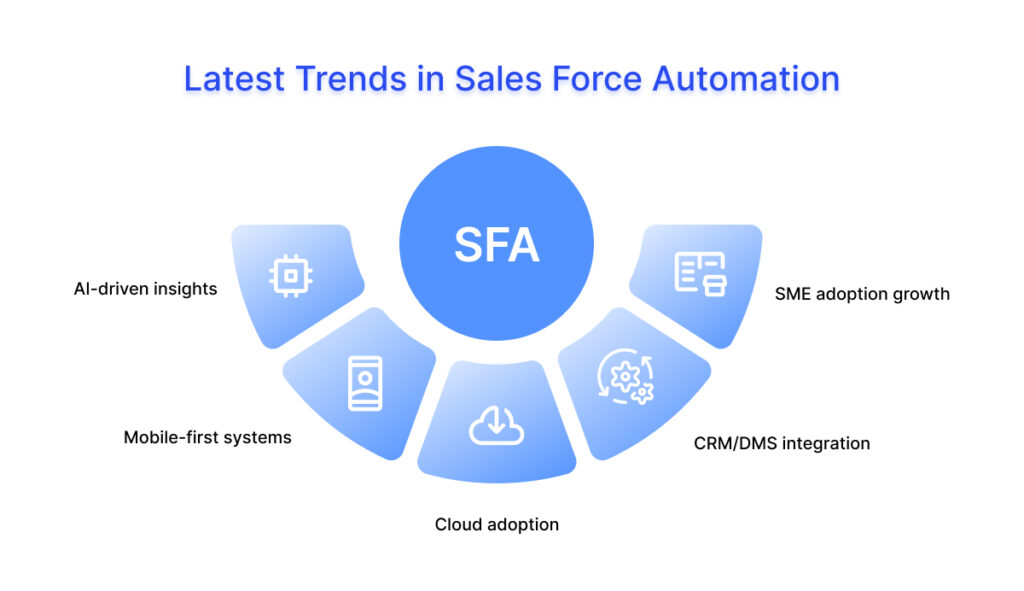
The SFA market is growing rapidly, especially in India, as FMCG businesses look for better visibility, speed, and control over field operations.
Key Trends
- Rising adoption among SMEs
More small and medium businesses are investing in a secondary sales tracking system in India to streamline field sales and improve execution.
- Shift to mobile-first solutions
An sales force automation mobile app is now central to daily operations, enabling sales teams to work efficiently from anywhere.
- AI-driven insights
Advanced field sales app is helping businesses analyse sales trends, predict demand, and make faster decisions.
- Integration with CRM and ERP systems
Modern FMCG sales tracking systemsare increasingly connected with CRM and ERP platforms for seamless data flow.
- Growth of cloud-based platforms
Cloud-based sales force automation solutions are preferred for their scalability, flexibility, and lower upfront costs.
For companies evaluating the best Sales Force Automation solutions FMCG businesses in India, the focus should be on tools that are scalable, mobile-first, and insight-driven. Adopting the right field sales management app is no longer optional. It is key to staying competitive in a fast-moving FMCG market.
The challenge in FMCG sales operations isn’t just reaching more outlets it’s gaining clear visibility into field execution every day. Without real-time insights, even well-structured teams can struggle to maintain consistent performance across territories. A sales force automation toolhelps centralise field activities, streamline reporting, and connect teams, enabling FMCG businesses to manage operations efficiently at scale. It’s not just a tool, it’s a way to bring clarity and control to your daily sales processes.
When evaluating a field sales management app, focus on how well it aligns with your field workflows, supports scaling sales teams, and is easy for your staff to adopt. The right solution ensures that data flows seamlessly, coordination is simplified, and execution becomes consistent across the market. The next step is to assess your current processes, identify gaps in visibility and execution, and select a system that addresses them effectively, setting your FMCG business up for structured, data-driven growth.
What’s really happening in your market right now? If you don’t know, you’re already behind. Discover how SFA gives you real-time answers.
Frequently Asked Questions
The difference between SFA & ERP is that SFA focuses on managing field sales activities like order booking, visit tracking, and sales reporting, while ERP handles overall business processes such as finance, inventory, and supply chain operations.
It reduces time spent on manual tasks, automates reporting, and provides real-time insights. This allows sales teams to focus more on selling and improving outlet coverage.
Start by defining clear objectives, mapping current workflows, selecting the right software, training your team, and rolling out a pilot program before full deployment.
SFA implementation can take anywhere from a few days to several weeks, depending on the complexity, integrations, and customisation required.
Yes, most SFA platforms use secure cloud infrastructure, data encryption, and role-based access to ensure sales data is protected.
The future of SFA includes AI-driven insights, predictive analytics, automation of decision-making, and deeper integration with CRM and DMS systems for end-to-end sales management.
An SFA app helps sales reps plan visits, take orders, track activities, and send real-time updates to managers.
Yes, most SFA tools come with mobile apps so sales reps can use them while working in the field.
Yes, most modern solutions offer offline functionality. Data can be captured without internet access and synced later when connectivity is available.
Yes, even small businesses benefit from better visibility, improved productivity, and structured sales processes, making it easier to scale operations.
During a customer visit, the rep selects the customer, browses the product catalogue, adds items to the cart with quantities, and submits the order — all within seconds. The order is instantly visible to the backend team for processing.
Heera SFA (Sales Force Automation) is a smart mobile and web-based platform that helps businesses manage their entire field sales operation — from tracking daily visits and orders to monitoring team performance in real time. It eliminates manual paperwork, reduces errors, and keeps your sales pipeline organised automatically.