

Indian FMCG growth has reached a point where many FMCG categories, multiple brands compete for visibility within the same retail outlets. For established FMCG brands, the challenge is no longer gaining distribution excellence but maintaining execution consistency across existing outlets.
The real battle begins after the listing, in how regularly the outlets are visited, how reliably replenishment happens, and how clearly schemes are executed on the ground. This shift is exactly why retail execution best practices for businesses in 2026 focus less on expansion and more on consistency, visibility, and daily execution at the outlet level.
When execution weakens, the signs are subtle. It shows up in everyday moments. A sales rep reaches late and skips a smaller retail store. A fast-moving SKU goes out of stock for several days until the next beat visit or distributor replenishment. Without systems like a distribution management system that tracks stock availability and distributor orders, these gaps often go unnoticed. A retailer asks, “Kal stock aa jayega na?” and hears, “Dekhte hain.” The shelf stays empty. No one flags it. But the retailer switches brands because sales cannot wait.
When such small conversations repeat across hundreds of stores and dozens of beats, the impact compounds. In India’s general trade, growth in 2026 will be decided by retail outlet productivity execution discipline at the outlet level, visibility into what is happening, and the ability to correct small gaps before they scale into lost market share. This article breaks down the retail execution best practices that matter now.
What Is Retail Execution in the General Trade Channel?
Retail execution in FMCG is the discipline of ensuring product availability, visibility, correct pricing and scheme execution and order generation across retail outlets through consistent field visits, beat adherence, retail outlet coverage, distributor coordination, and structured sales processes.
In general trade, this includes product availability and visibility, beat adherence and retail outlet coverage, correct pricing and scheme execution, timely order booking and replenishment, and merchandising discipline.
On paper, retail execution looks structured. On the ground, it is fragmented and heavily dependent on people, processes, and data quality.
A beat plan says 45 outlets. By evening, only 32 are visited. A kirana store is skipped because it is “low value.” A scheme is mentioned briefly, not explained properly. One fast-moving SKU goes out of stock for two days. None of this feels like a big failure in isolation. But across hundreds of outlets, it steadily changes outcomes.
Given the diversity of general trade outlets in India, execution quality often varies from market to market. Strong retail execution helps close the gap between central planning and store-level reality.
Core Components of Retail Execution in FMCG General Trade
Retail execution in FMCG general trade goes beyond outlet visits and order booking. It involves a set of measurable components that determine how effectively a brand is represented and sold inside retail stores. Key retail execution components include:
- Numeric Distribution: Numeric distribution refers to the number of outlets that stock a particular SKU or brand in a market. Strong retail execution helps maintain and expand this coverage by ensuring regular outlet visits and timely replenishment. When coverage becomes inconsistent, retailers may stop stocking certain SKUs, gradually reducing numeric distribution.
- Weighted Distribution: Not all outlets contribute equally to sales. Some high-throughput stores generate significantly higher volume than others. Weighted distribution focuses on ensuring product availability in these high-impact outlets. Presence in high-volume stores often has a disproportionate effect on overall sales velocity, making it a critical component of FMCG retail execution strategy.
- Retail Outlet Productivity and Segmentation: In FMCG markets, retail outlet productivity varies across the network, with some high-throughput outlets generating a larger share of category sales. Companies, therefore, segment stores into A, B, and C outlets based on sales potential and order frequency. Prioritising A-class outlets while maintaining consistent coverage across other stores helps improve retail execution and distribution efficiency.
- Share of Shelf: Availability alone does not guarantee sales. Shelf visibility strongly influences retailers’ recommendations and consumers’ choices. Share of shelf refers to the space a brand occupies compared to competitors and how visible its products are. Maintaining strong shelf share and consistent in-store merchandising helps brands remain visible in crowded FMCG categories.
- Planogram and Merchandising Compliance: Retail execution also involves ensuring products are displayed in accordance with merchandising guidelines. This includes planogram compliance, in-store merchandising standards, POSM deployment, shelf displays, cooler placement, and counter visibility,often supported by in-store promoter applications that track merchandising tasks and store activity. Merchandising discipline ensures that products are not only available but also visible & correctly positioned to influence buying decisions.
- Range Selling: Retailers often prefer stocking only fast-moving SKUs. However, strong execution ensures the full product range reaches the shelf. Range selling focuses on ensuring that retailers stock the correct assortment rather than a limited set of high-rotation products. Maintaining the right SKU mix helps brands increase basket size, improve category visibility, & strengthen shelf presence.
Building on these components, FMCG companies structure their efforts into six strategic pillars to ensure consistent execution across markets.
Top 6 Retail Execution Pillars in FMCG
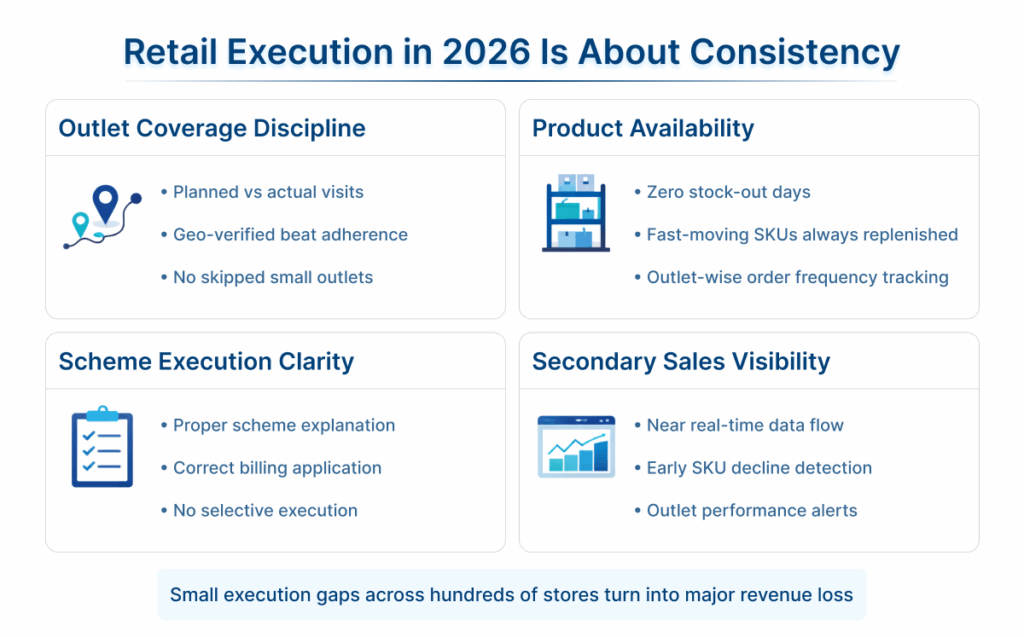
While the core components highlight what drives retail execution, FMCG companies often organise these into the top six strategic retail execution pillars. Focusing on these pillars helps align field teams, distributors, and managers to deliver consistent results, improve outlet coverage, & drive sales performance across all markets.
- Outlet Coverage Discipline
Consistent visits to all outlets according to beat plans help maintain market presence and prevent missed sales opportunities. - Product Availability & Stock Replenishment
Tracking SKU availability and ensuring timely replenishment prevents stock-outs, supports retailer trust, and drives secondary sales. A detailed explanation of how these platforms work can be found in this complete guide to a Distribution Management System. - Merchandising & Visibility
Adhering to planograms, POSM placement, and merchandising guidelines maximizes shelf visibility and influences purchase decisions. - Range Selling & SKU Expansion
Encouraging retailers to stock the full product range increases category visibility, basket size, and brand presence. - Distributor Coordination
Close collaboration with distributors ensures on-time deliveries, smooth order processing, and consistent service across high- and low-throughput outlets. - Data Visibility & Response Speed
Real-time access to sales data, stock levels, and outlet performance enables quick corrective actions, preventing small execution gaps from becoming lost revenue.
Focusing on these six pillars strengthens FMCG retail execution, boosts outlet-level performance, and builds a scalable foundation for sustained growth in competitive markets.
Why Retail Execution Will Be a Key Growth Driver in 2026
By 2026, most FMCG and CPG companies in India will already have a wide distribution reach across the general trade channel. The real difference will not be how many retail stores are covered, but how well those outlets are serviced through consistent retail execution in FMCG.
Despite the growth of modern trade and e-commerce, general trade still contributes the largest share of FMCG volumes in India
Kirana stores in India are not disappearing; they are evolving. Any outlet-level execution gap directly impacts secondary sales. Rising input costs and tighter distributor liquidity also mean that inefficient execution is no longer affordable. Many FMCG companies are now re-evaluating their distribution models and sales processes to overcome common FMCG distribution challenges and maintain consistent retail execution across markets.
Companies that invest in retail execution excellence will be better placed to protect market share and drive steady growth.
Biggest Retail Execution Challenges in General Trade
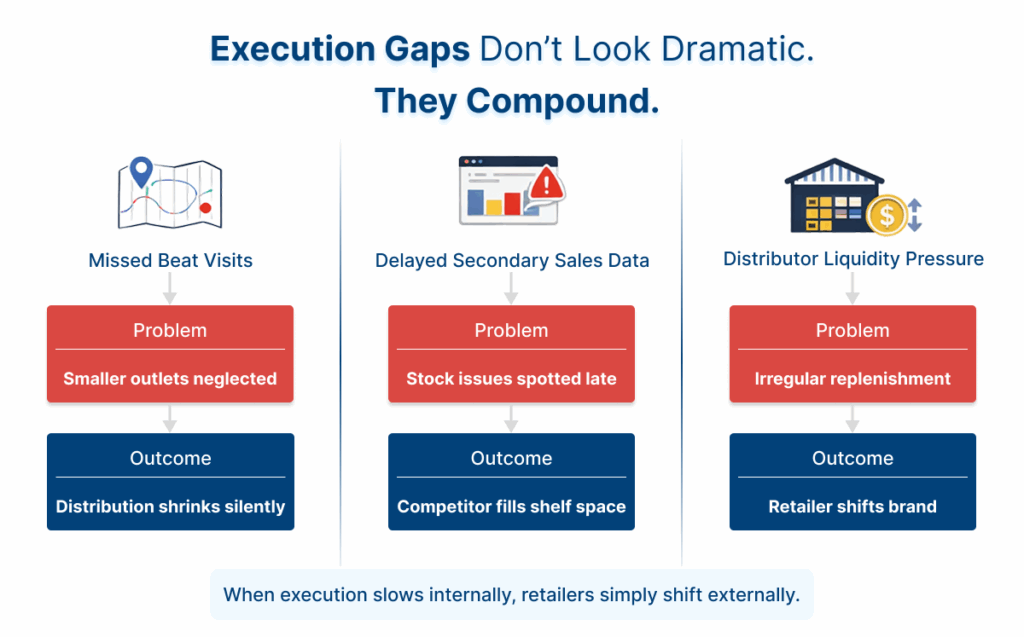
Retail execution challenges in general trade often break down quietly at the outlet level, even when FMCG planning looks strong. Many brands struggle with missed visits, delayed stock replenishment, and inconsistent trade scheme communication, which reduces product availability and visibility in retail kirana stores. Limited secondary sales visibility and distributor constraints make it harder to spot these issues early. Over time, small execution gaps compound, leading to lost sales, weaker retailer trust, and slipping market share. Understanding these challenges is the first step toward implementing effective retail execution practices that protect growth.
- Inconsistent Beat Execution: Beat plans are designed for structured coverage and improved call productivity, but inconsistent beat execution arises when sales reps adjust beat plans under daily targets, prioritising large retail outlets and leaving smaller stores overlooked, reducing orders and visibility over time. In many FMCG organisations, sales managers often struggle to track execution metrics such as strike rate, call productivity, sales per outlet, SKU distribution, and order conversion rate, which help determine whether outlet visits are translating into meaningful sales outcomes.
- Delayed Secondary Sales Visibility: Many teams still depend on manual or delayed secondary sales reports. By the time secondary sales visibility reaches the head office, the data is already outdated. This limits timely action on stock gaps, declining outlets, and slow-moving SKUs. For Eg: A slow-moving SKU is noticed after three weeks. A shrinking outlet is flagged at month-end. By then, the competitor has already filled the gap.
- Distributor Dependency and Cash Flow Pressure: Distributor dependency in general trade is a critical factor. Pressure on the working capital cycle, secondary billing expectations, and the complexity of sub-stockist networks and redistribution stockists (RS) can affect service levels. When distributor ROI becomes strained, inventory push may replace true sell-through, creating execution gaps across the route-to-market
- Scheme Leakage and Miscommunication: Schemes designed at the head office often lose impact at the retail store level. Poor trade scheme execution & communication & selective execution reduce scheme effectiveness and weaken retailer trust.
How Can Businesses Build Execution Discipline at Scale?
Retail execution in general trade cannot rely on individual salesperson effort alone. Inconsistent visits, missed orders, and uneven scheme implementation can quietly erode sales and market share, even when central planning looks strong. Strong execution discipline also depends on structured beat optimisation, route planning, and field productivity management. Regular retail audits and clear visibility into market coverage help companies identify missed outlets, shrinking stores, and execution gaps early.
To scale execution effectively, companies need system-driven discipline that ensures structure, visibility, and accountability at the outlet level. This involves creating clear processes, defining daily objectives, and monitoring performance in real time. By standardising how sales reps interact with outlets, track SKUs, and implement schemes, brands can reduce variation and ensure every outlet receives consistent attention.
Key best practices include:
- Digitised beat plans with geo-verified visits to confirm that planned coverage is completed.
- Mandatory outlet coverage tracking to quickly identify missed visits, shrinking outlets, or neglected stores.
- Clear daily execution KPIs-focusing on productive calls, order frequency, and SKU presence rather than just monthly targets.
In 2026, it is consistent, not occasional, high-performance efforts-that drives sustainable growth. Businesses that implement disciplined, system-driven execution at scale will not only prevent revenue leakage but also strengthen retailer trust and long-term market presence.
How Should Companies Use Technology for Retail Execution?
By 2026, effective retail outlet execution in FMCG general trade depends on how well technology connects field activity, distributor operations, and market visibility. When these systems operate in isolation, execution gaps become harder to detect.
A sales manager tracks primary dispatch.
The distributor manages inventory independently.
The field team records activity on another platform.
The result is fragmented visibility across the sales network. For technology to support retail execution effectively, it must strengthen core field activities such as:
- Consistent beat adherence
- SKU level availability tracking
- Fast and accurate order capture
- Visibility of secondary sales
When designed correctly, technology reduces field complexity. It allows sales teams to spend less time reporting and more time improving product availability, visibility, and retailer relationships.
In most FMCG organisations, technology improves execution by strengthening essential operational capabilities across the sales network. These typically include system integration, real-time field visibility, sales team productivity, and stronger coordination with distributor partners.
- Integrating Sales Force Automation, Distribution Management System, and Retail Execution System
Sales force automation, distributor management systems, and retail execution software or merchandising applications must work as one. Integration ensures that primary dispatch, secondary sales, and field activity are connected in near real time. - Enable Real-Time Execution Visibility
Connected systems allow teams to track outlet coverage, visit adherence, stock availability, and merchandising compliance as it happens. This helps managers spot issues early instead of reacting after the cycle ends. - Improve Field Team Productivity
Clear visit plans, outlet-wise objectives, and automated reporting improve field productivity while reducing manual administrative work. Sales reps can focus more on execution and less on administration. - Strengthen Distributor Coordination
Integrated systems improve visibility into inventory, orders, and secondary sales. This supports faster replenishment and reduces outlet-level stock-outs. - Support Faster and Better Decision-MakingWhen execution data flows in near real time, leadership teams can take timely, data-backed decisions that reflect actual market conditions.
- But visibility alone is not execution. Over-investing in dashboards without fixing on-ground execution only creates the illusion of control. If beat discipline is weak, outlet coverage is inconsistent, or distributors cannot service routes reliably, no amount of reporting will change the outcome.
Technology creates the visibility and structure needed to manage retail execution across complex sales networks. When combined with disciplined field operations and strong distributor coordination, it helps businesses maintain consistent performance across markets.
Related reading you may find useful:
“Why Sales Force Automation Is Becoming the Backbone of FMCG Growth in General Trade”
How Should Data Be Used for Action, Not Reporting?
In general trade, data is valuable only when it leads to action. Reports that arrive late or need heavy analysis often end up as review material, not decision tools. Effective retail execution requires information that highlights trends, flags exceptions, and guides quick corrective steps at the outlet level, enabling field teams and managers to act in real time.
Retail execution data should help teams answer simple daily questions:
- Which outlets are slipping in outlet-level performance tracking?
- Which SKUs are losing distribution or visibility?
- Which beats are consistently underperforming?
Dashboards should be built for sales managers and field teams. The focus must be on alerts, trends, and exceptions that trigger quick action, not complex reports reviewed weeks later.
What Will Differentiate Winning FMCG Brands in 2026?
In 2026, FMCG growth in India will not come from rapid expansion alone. Brands that combine execution consistency with strong retailer relationships, near real-time secondary FMCG sales automation visibility, and empowered field teams gain a decisive edge. Integrating these elements into a cohesive FMCG retail execution strategy ensures that growth is sustainable, measurable, and resilient across general trade markets.
1. Execution Consistency Over Aggressive Expansion
Expanding distribution without strong retail execution creates a weak market presence. Brands that focus on consistent outlet coverage, product availability, and in-store visibility across general trade build stronger and more durable market share.
2. Strong Retailer Relationships, Not Just Incentives
Retailers in general trade value reliable supply, clear communication, and fair scheme execution more than short-term discounts. Brands that invest in long-term retailer relationships earn shelf preference and loyalty, especially in crowded FMCG categories where competition for visibility is high.
3. Visibility of Secondary Sales, Not Only Primary Numbers
Brands that track what is selling in general trade outlets in India can respond faster to market changes, correct retail outlet execution gaps early, and plan growth with greater accuracy. Secondary sales visibility is more indicative of market performance than primary sales alone.
4. Empowered Field Teams with Simple Execution Tools
Field teams perform best when systems support daily execution, reduce reporting effort, and clearly guide outlet visits, order booking, and merchandising priorities.
In 2026, FMCG brands that integrate execution, data insights, and field capabilities within a strong FMCG retail execution strategy will drive sustainable growth in general trade
Sustainable FMCG growth is built at the outlet, not in spreadsheets. Strong retail execution excellence ensures products are available, visible, and correctly serviced across markets. When this foundation, i.e. execution, is weak, expansion only magnifies the problem. In 2026, brands that prioritise execution readiness, invest in field capability, and stay connected to market realities will grow with confidence. Their growth will be slower to fade and easier to scale.
Frequently Asked Questions
Retail execution is how well an FMCG brand implements its sales plan at the outlet level, including visit discipline, product availability, order booking, scheme execution, and replenishment in general trade stores.
Because general trade drives most FMCG volumes in India, even small execution gaps like missed visits or stock-outs directly reduce secondary sales and market share.
Sales force automation brings structure to field sales by tracking beat plans, retail store visits, orders, and execution data in real time. It also helps improve salesmen’s productivity, market visibility, and order capture. You can explore some of the most useful capabilities in this article on features to have in a modern sales force automation platform.
Distributor management ensures inventory availability, timely order fulfillment, and secondary sales visibility, which are essential for consistent outlet servicing.
The most common retail execution failures in the general trade FMCG channel include missed outlet coverage, stock-outs, poor scheme execution, delayed order booking, and weak execution monitoring across general trade outlet Management.
Poor retail execution workflow in general trade directly impacts secondary sales tracking by reducing product availability, visibility, and sales velocity at the outlet level, allowing competitors to replace the brand.
Retail execution breaks down due to weak sales execution processes, heavy distributor dependency, manual workflows, delayed execution visibility, and inconsistent field sales execution across the GT route-to-market network.
Key FMCG retail execution KPIs include productive calls, order booking process efficiency, SKU availability, stock-out frequency, outlet-level execution quality, and merchandising compliance.
Distributor liquidity directly affects the distributor sales process, influencing stock replenishment processes, service frequency, and execution consistency across general trade outlets.
Strong general trade outlet management & execution builds retailer trust through consistent servicing, reliable stock availability, and fair scheme execution, improving long-term shelf presence.
Beat frequency refers to how often a sales representative visits retail outlets in a defined route or beat plan to capture orders, check stock availability, and maintain retailer relationships.
A retailer’s credit cycle is the time period given to retailers to pay for purchased stock. Common credit cycles in general trade vary from one brand to brand.