

According to Roosevelt Dsouza, Head of Customer Success (NIQ, India). – The growth of the FMCG industry continues to be driven by consumption trends in the 1st Quarter of 2024 (JFM’24). Rural areas have surpassed urban growth for the first time in the fifth quarters. Notably, the food categories have outperformed the Home and Personal Care (HPC) products. The food categories have witnessed higher unit purchases. On the other hand, the growth of HPC has been driven by the popularity of larger pack sizes, highlighting the growing need for an efficient distribution management system to ensure consistent availability and supply across regions. This shift underlines how FMCG digital transformation and the adoption of distributor software in India are becoming key enablers of speed, visibility, and control across supply networks.
These trends show the high relevance and significance of offline distribution in the FMCG market. To meet the pace of change, companies are increasingly investing in sales automation systems and FMCG route-to-market strategies that bridge gaps between demand and supply. In this e-commerce and quick commerce period, offline distribution channels remain essential, and it’s important to note that rural areas still prioritise physical retail networks as their preferred choice.
The efficiency of an offline distribution network acts as a key factor in the CPG market. A traditional approach to supplier network management can hinder growth. It not only leads to slowdowns and financial losses but also creates several distribution challenges. These challenges could be pricing discrepancies, distributor inventory management, and tracking promotional schemes.
But choosing a Distribution Management System (DMS) moves a company forward. It gives a tech advantage that makes it stand out from the competition.
Why do CPG companies need a distributor management system?
The right Distributor Management System can improve your distribution workflows while also improving distribution visibility across all sales touchpoints with the help of a distribution visibility tool, giving businesses better control over operations. It enhances the supply chain’s efficiency and helps solve issues like overstocking or shortages. Real-time access to distributor data is critical for fast, informed decision-making, which is why having up-to-date information within the distributor network is essential for smooth and efficient distribution.
These benefits allow a company to operate at its true potential, regardless of its size – be it a small, medium, or large enterprise. Additionally, a DMS supports channel partner management by aligning distributors, sub-stockists, and retailers under a unified digital ecosystem.
Recommended Blogs to Read
What is a Distribution Management System
Thus, this article explores the top ways a DMS software for FMCG can boost your business in a profitable direction.
7 Ways a Distribution Management System (DMS) Helps Increase Business Profits
A good Distribution Management System (DMS) can do much more than track sales or inventory. It gives FMCG and CPG companies the visibility and control they need to run smoother, faster, and more profitable operations. From managing schemes and claims to preventing stockouts and automating tax compliance, a DMS simplifies the everyday complexities of distribution. Modern DMS software for FMCG brands further helps improve transparency and ensure every process contributes to better profitability. Below are seven practical ways DMS helps increase business profits.
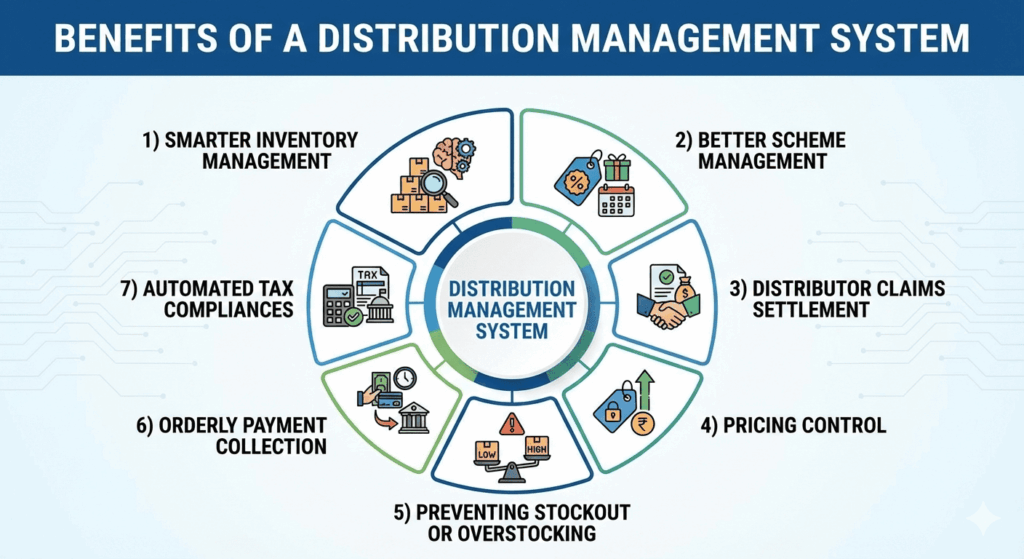
1) Demand Forecasting for Smarter Inventory Management
- A Distributor Management System (DMS) aka Inventory Management System for FMCG ensures transparent and real-time inventory visibility at distributor points. It aligns inventory movements with sales and orders.
- Integrated demand planning tools within modern DMS platforms make forecasting more accurate, reducing losses and improving supply chain responsiveness.
2) Better scheme management
- DMS facilitates the automation of scheme creation and application. It provides a straightforward process. Ithelps in trackingsecondary schemes, those passed through distributors to retailers.
- DMS also enhances transparencybyoffering companies a clear view of market activities. It simplifies the scheme application. DMS also ensures that the budget allocated for secondary schemes intended for retailers is effectively passed on to the retailers. It is one of the key benefits of using a Distribution Management System in supply chain management.
3) Distributor Claims Settlement
- Let’s understand how a Distribution Management Software works in claims settlement. Building on scheme automation, DMS extends to claim automation. At month-end, distributors can generate both scheme-based and non-scheme-based claims. Overall, it offers a clear overview. Once raised properly, the company can ensure a streamlined payout process. This also enhances accuracy in stock reconciliation and reduces manual claim errors.
- This automation reduces claim conflicts. It provides substantial time savings and transparency. DMS helps elevate efficiency and clarity for all stakeholders in claim management.
4) Pricing Control
- How does pricing control work in a DMS? The answer issimple: DMS enables companies to control product pricing effectively. It ensures that distributors, during retailer billing, cannot modify product prices. The Distribution Management System safeguards against market price manipulation. It sets varied prices and margins, based on different areas/regions, products, and batches.
- Additionally, it enables grouping multiple SKUs under a parent code for accurate reporting, considering subtle packaging or volume changes. With every bill, DMS guarantees correct product pricing for each retailer. It helps the brand achieve reliable distributor pricing control.
5) Preventing Stockout or Overstocking
- DMS grants visibility into distributor inventory. It helps analyse product-wise stock levels and movement trends. This allows the creation of norms and processes to prevent stockouts.
- Simultaneously, itidentifies instances of overstocking, where excessive distributor investment is tied up. DMS for CPG brands allows businesses to take prompt action. It ensures a balanced approach to inventory management. Further, it prevents both stockouts and overstocking scenarios. DMS insights also offer SKU-level visibility to track each product line’s performance, ensuring precise inventory control and replenishment decisions.
6) Orderly Payment Collection
- DMS acts as an order and billing software for distributors. It simplifies order management for distributors. It helps them convert orders into bills based on available stock.
- This retail sales tracking software enables tracking outstanding and receivables. It results in marking payment collections against receivables.
- With FMCG Distribution Software, the payment collection process becomes straightforward. This feature promotes organised financial transactions and better cash-flow visibility.
7) Automated Tax Compliances
- DMS is renowned as the best ERP for sales and distribution management in CPG industry. This GST compliance software for distributors allows seamless generation of Tax and GST reports. The reports are exportable in a Tally-compatible format.
- It promotes easy adoption and ensures the success of the implementation. The Distribution Management Software is definitely a way for digital transformation in distribution for a CPG brand. However, capitalisation of its full potential depends on the Distributor. Thus, let’s thoroughly understand the Distributor’s role in Supply chain management for FMCG.
Role of distributor in Retail supply chain optimization
The Role of Distributor in Retail Supply Chain Optimization goes far beyond product delivery. Distributors act as the crucial link connecting manufacturers and retailers, ensuring products move efficiently through every stage of the FMCG and retail supply chain. Their involvement helps brands maintain steady product availability, manage stock levels, and meet market demand on time. A well-structured distribution management process not only supports timely deliveries but also enhances visibility and efficiency across the supply chain.
Below are the key distributor roles that highlight how distributors drive retail supply chain optimization. As FMCG supply chain digitization advances, distributors now rely on data-driven insights to make better fulfillment and stock allocation decisions.
1. Direct-to-Retail Distribution: In this pathway, manufacturers supply products to distributors, who then deliver further to retailers. This approach is very direct and simple. It minimizes complexities in CPG supply chain management and accelerates the availability of products.
2. Wholesale-Integrated Distribution: In this model, Products move from manufacturers to distributors. Further, the product passes through wholesalers before finally reaching retailers. This mechanism is quite common in Industries. It is used to handle large volumes. The objective of using this model is to achieve better stock management at multiple levels.
3. Direct-to-Consumer Distribution: In recent times, manufacturers have started bypassing intermediaries. In this model, the brand sells directly to consumers via direct sales or e-commerce. Here, the role of the distributor gets reduced or nearly eliminated.
How can FMCG companies improve distribution efficiency?
In the CPG industry, where time is money, an efficient Distribution Management System (DMS) becomes the key to saving both. It strengthens the route-to-market strategy for CPG brands. It’s like having a well-organized remote control for your entire sales process.
The more you sell, the more money you make, paving the way for a brighter future for your business. A reliable DMS for FMCG isn’t just about efficiency; it’s about creating a super-smooth sales and delivery system. It ensures smooth collaboration across your sales and distribution ecosystem.
At Heera Software, we deliver customized DMS solutions that simplify your supply chain operations. The solutions that help your brand manage the supply chain network efficiently. For more information, please book a demo with Heera Software.
Frequently Asked Questions
The best ERP-integrated DMS solutions for FMCG companies is Heera Software’s DMS. Heera Software’s DMS is the best distribution management software for FMCG. It ensures seamless inventory, sales, and trade promotion management.
Yes, Heera Software’s DMS can integrate with ERP and CRM systems. It enhances data accuracy, digitizes order processing, and improves customer relationship management.
Distributors need automated payment tracking to manage receivables efficiently, reduce errors, and ensure timely payments. A B2B distributor software with automated invoicing and reconciliation helps maintain financial accuracy.
Heera DMS optimizes trade promotions in FMCG. It automates scheme creation and ensures real-time tracking. It also provides insights into budget utilization. It helps distributors apply promotions accurately and measure their effectiveness for better ROI.
Digital transformation in FMCG helps companies automate their entire distribution process—from order management and invoicing to trade promotion optimisation. With tools like Heera’s DMS, brands gain real-time visibility.
Distribution analytics in FMCG helps brands monitor sales, track channel performance, and identify demand trends across regions. It enables data-driven decision-making that improves order accuracy, inventory planning, and overall supply chain efficiency.
Trade promotion optimization allows FMCG brands to measure, analyze, and improve their promotional strategies. Using automated tools within a DMS, companies can allocate budgets efficiently, track ROI, and ensure promotions reach the right retailers.
A robust distributor software in India streamlines channel partner management by connecting manufacturers, distributors, and retailers on a single digital platform.
A sales automation system simplifies order-taking, tracking, and billing for field sales teams. It minimizes manual errors, improves order accuracy, and ensures faster data syncing between distributors and sales representatives.
Modern Distribution Management Systems provide SKU-level visibility, allowing brands to track each product’s movement, performance, and availability across regions. This granular view supports better stock planning and prevents stockouts or overstocking.