
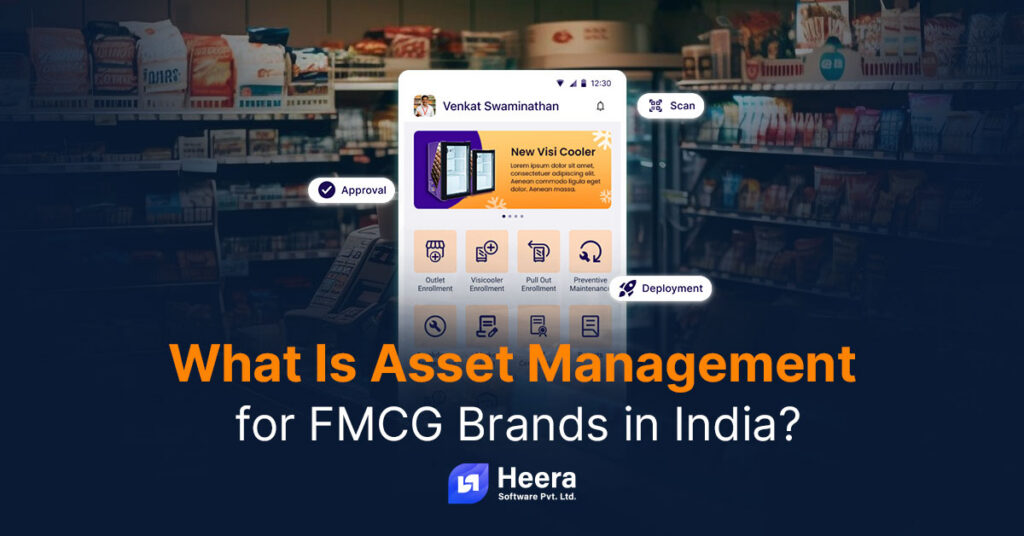
FMCG brands in India deploy lakhs of coolers, racks, and POSM materials across vast retail networks, yet many still lack clear visibility into what happens after placement. This is where capabilities like cooler tracking solution and Point of Sale Materials (POSM) compliance monitoring become critical, but are often missing in traditional setups.
That lack of visibility is exactly what asset management is built to solve. Asset management for FMCG brands is the process of tracking, monitoring, and optimising physical assets across the retail network, ensuring they are correctly placed, functional, and contributing to sales.
In simple terms, it answers one question:
Where are your assets, and are they working for you? This clarity rarely exists.
In reality, this clarity rarely exists. A cooler is placed in a retail store. A few months later, no one knows if it’s working, moved, damaged, or even still there. Point of Sale Materials (POSM) materials are dispatched in bulk, but whether they are displayed remains unclear.
Field teams report that everything is “done.” Distributors confirm assets are “allocated.”
In reality, this isn’t just a tracking issue. Beat plan pressure pushes reps to mark visits as complete without always entering stores. Incentives reward coverage over quality, and with little consequence for inaccurate reporting, gaps quietly build over time.
So when sales dip, there’s no reliable way to trace the issue. This is the silent operational gap in many FMCG setups: assets are deployed, but on-ground visibility is missing. As retail formats expand and execution becomes more complex, this gap directly impacts sales, compliance, and ROI.
If you’re here, you already understand that assets play a critical role in retail execution. The real question is whether they are delivering value. Are your coolers being used as intended? Are your displays visible and set up correctly? Or are they placed and forgotten over time?
For most brands, deployment isn’t a problem. The real challenge begins after assets reach the market, when there is little clarity on usage, condition, or impact on sales. This guide is designed to solve that problem. It breaks down what asset management means in an FMCG context, which assets need tracking, and why outlet-level visibility directly affects execution. You’ll also see where traditional methods fall short, how modern systems close these gaps, and what capabilities matter when choosing a solution. If you’re looking to move from assumptions to real, store-level visibility across your retail network, this will help you get there. So, let’s understand how FMCG brands can achieve this level of visibility at scale in the upcoming blog:
What Is FMCG Asset Management Software and How Does It Work?
What Is FMCG Asset Management?
FMCG asset management is the process of tracking, monitoring, and optimising physical assets – including coolers, freezers, display racks, and POSM materials – deployed across retail outlets and distribution networks.
FMCG asset management software automates this process using geo-tagging, image-based verification, and real-time dashboards to give brands complete visibility into where every asset is, whether it is functional, and whether it is contributing to sales – across every outlet, every day.
An Trade Asset Management System (TAMS) is a digital system that helps brands track, monitor, and manage physical assets like coolers and POSM, and determine whether they are functioning as expected across the distribution network.
Instead of relying on manual updates from distributors or field teams, the system gives direct field intelligence of where each asset is, how it’s being used, and whether it is functioning properly.
What does it actually do?
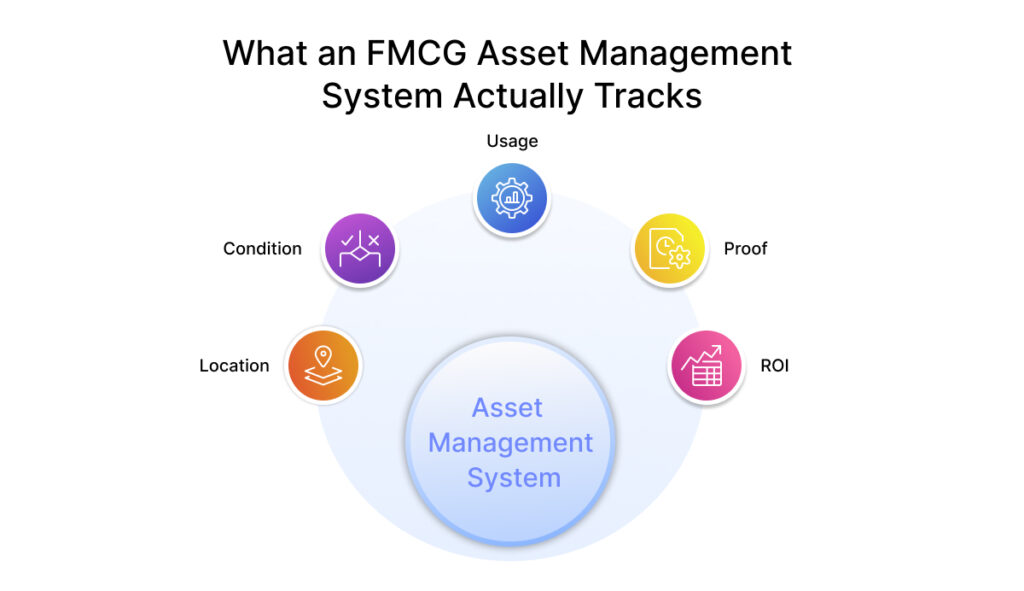
A typical retail asset management system allows brands to:
- Track asset location at the outlet level
- Monitor usage and working condition
- Capture image-based proof from field visits
- Identify missing or “ghost assets”
- Manage maintenance and service requests
- Measure asset performance and ROI
This is especially critical in FMCG, where assets are spread across thousands of outlets and directly influence secondary sales visibility and retail execution.
Without a structured system, brands are forced to depend on delayed reports and assumptions. With the right asset tracking software for FMCG, they can understand actual in-store execution, as it happens.
What Are Examples of Assets in FMCG Distribution?
Common FMCG Assets That Require Tracking:
- Visi-coolers and refrigeration units (highest cost, highest revenue impact if non-functional)
- Display racks and shelving fixtures
- POSM materials – posters, danglers, standees, shelf strips
- Signage and branded branding units
- Sampling kiosks and promotional setups
- Delivery vehicles (tracked separately via fleet management systems)
Of these, visi-coolers and POSM carry the highest execution risk – coolers because of the direct link between uptime and secondary sales, and POSM because of the volume deployed and difficulty of verifying.
Assets in FMCG distribution include physical items deployed at retail outlets to improve product visibility, storage, and sales. In FMCG operations, “assets” go far beyond warehouses and vehicles. They are often deployed directly at retail outlets.
Here’s what typically falls under FMCG asset management:
- Coolers and freezers (visi-coolers for beverages, ice cream units)
- Display racks and shelves
- POSM materials (posters, danglers, standees)
- Signage and branding units
- Delivery vehicles
- Sampling kiosks or promotional setups
Each of these directly impacts retail transparency, brand recall, and ultimately sales.
POSM Tracking System vs Cooler Tracking System in FMCG
Aspect | POSM Tracking System | Cooler Tracking System |
Primary Purpose | Ensure branding visibility and display compliance | Ensure product storage, availability, and cooling |
Type of Assets Tracked | Posters, danglers, standees, signage | Visi-coolers, freezers, chillers |
Impact on Sales | Indirect (drives visibility and brand recall) | Direct (impacts product availability and impulse purchase) |
Key Validation Method | Image-based verification (is it displayed correctly?) | Image + condition check (is it working, switched on?) |
Common Issues | Not installed, removed, damaged, misplaced | Switched off, non-functional, used for competitor products |
Maintenance Requirement | Minimal (replace or reinstall) | High (repairs, servicing, uptime tracking) |
Field Team Role | Verify placement and visibility | Verify usage, condition, and functionality |
In simple terms:
POSM tracking ensures your brand is seen.
Cooler tracking ensures your product is sold.
How does an FMCG Asset Tracking Software for the field team work
How FMCG and CPG Asset Management Software Works:
- Asset Allocation:- Every cooler, rack, or POSM unit is assigned a unique ID and mapped to a specific outlet or distributor in the system.
- Geo-Tagging:- Each asset is linked to precise GPS coordinates at the point of deployment.
- Field Verification with Image Proof:- Field reps photograph asset placement and condition during store visits; photos are auto-tagged with location, time,
and rep name. - Maintenance Tracking:- Damaged or missing assets are flagged instantly, service requests are created, assigned, and tracked to resolution.
- Lifecycle Monitoring:- Every repair, redeployment, or replacement is recorded, giving brands a full history of each asset’s performance and cost.
- Analytics and Reporting:- Dashboards show asset utilisation, compliance rates, non-productive units, and ROI by outlet, territory, and region
A modern FMCG asset management system brings structure and clarity to what is otherwise a very scattered, hard-to-track process, it creates a clear, trackable flow of how assets move and perform in the market. Here’s how it typically works in real-world FMCG operations:
1. Asset Allocation
The process starts when assets such as coolers or Point of Sale Materials (POSM) are assigned digitally to a distributor, territory, or directly to a retail outlet. This ensures every asset has a recorded owner and location from day one, reducing confusion and dependency on manual records.
2. Geo-Tagging
Once deployed, each asset is linked to a specific outlet using location data. This allows brands to see exactly where assets are placed across regions, cities, and individual stores, instead of relying on distributor-level visibility.
3. Field Verification
During regular market visits, sales reps or promoters verify whether the asset is present at the outlet. This step ensures that what is recorded in the system matches what exists on the ground.
4. Image Capture
Field teams capture photos of retail assets or POSM during visits as proof of placement and condition. This removes ambiguity and replaces verbal updates with visual confirmation, making it easier for managers to trust the data.
5. Maintenance Tracking
If an asset is damaged, not working, or missing, it can be reported instantly through the system. Service requests are logged, tracked, and monitored until resolution, helping reduce downtime and ensuring assets remain usable.
6. Lifecycle Monitoring
From the moment an asset is deployed to when it is repaired, replaced, or removed, every activity is recorded using asset lifecycle management software. This helps brands understand how long assets are being used, how often they require maintenance, and whether they are delivering value over time.
Challenges in Traditional Asset Management (FMCG)
Traditional FMCG asset management faces challenges like a lack of on-ground clarity, manual tracking, and delayed reporting, which impact execution and ROI. Traditional asset management for FMCG brands often relies on manual processes that limit on-ground clarity, accuracy, and control. These outdated methods create operational blind spots that directly impact sales and asset ROI.
Challenges in Traditional Asset Management (FMCG)
- Manual tracking in Excel or paper logs
Asset data is recorded manually, making it error-prone, inconsistent, and difficult to update at scale. - No real-time visibility across outlets
Brands lacks a clear, up-to-date view of where assets are deployed and whether they are actively being used at stores - Heavy dependency on distributors for updates
Asset updates rely on indirect reporting, leading to delays, miscommunication, and limited accountability. - No proof of asset placement or condition
There is no reliable way to confirm whether assets are correctly installed, visible, or functioning at the outlet. - Delayed or inaccurate reporting
Data is collected and shared after long gaps, making it unreliable for timely decision-making.
Without a structured FMCG asset tracking system (ATS), brands operate with limited on-ground clarity and delayed insights.
This leads to:
- Inconsistent in-store execution across outlets
- Unnoticed asset loss or misplacement (ghost assets)
- Weak brand presence at the point of sale
- Lost opportunities due to execution gaps
These gaps create a clear disconnect between asset investment and actual on-ground performance.
Asset Management in FMCG: Manual vs Digital Approach
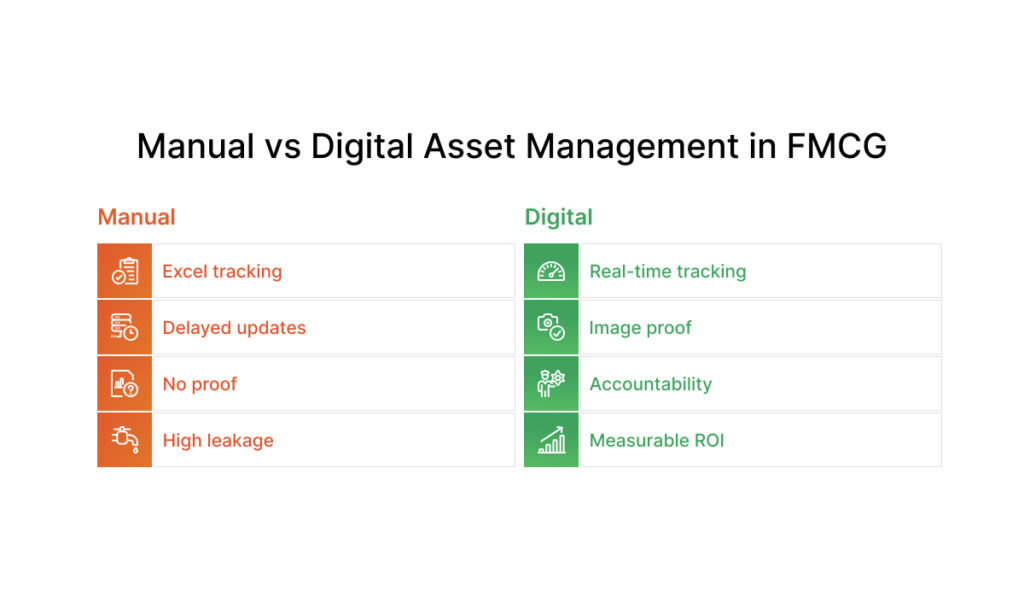
FMCG brands can manage assets manually or through a digital system, but the difference in execution, accuracy, and business impact is significant. Here’s a clear comparison:
Manual vs Digital Asset Management in FMCG
Aspect | Manual Approach | Digital Asset Management Software |
Tracking | Assets tracked in Excel or via distributor updates | Assets mapped digitally to each store with real-time updates |
Accuracy | High chances of errors and outdated records | Accurate, system-driven data with minimal manual errors |
Speed | Delayed updates and slow reporting cycles | Instant updates from field activity and store visits |
Accountability | No clear ownership or proof of execution | Image-based proof and user-level accountability |
Asset Status | No clarity on working condition or usage | Live tracking of asset condition and performance |
Maintenance | Issues reported late or not at all | Service requests logged and tracked in real time |
Decision-Making | Based on assumptions and delayed inputs | Based on real field data and store-level insights |
ROI Visibility | Difficult to measure asset performance | Clear visibility into utilisation and impact on sales |
In a manual setup, assets are deployed but rarely monitored effectively. Over time, this leads to missing assets, poor in-store execution, and lost sales opportunities. With a digital system, every asset becomes trackable, verifiable, and measurable. Brands can quickly identify gaps, fix issues, and ensure assets are consistently contributing to sales at the store level.
In simple terms, manual systems focus on deployment, while digital systems focus on performance.
Why Asset Management Matters in FMCG
If assets are not tracked properly, the impact is not gradual, it shows up quickly in execution gaps, lost visibility, and missed sales. In FMCG, where assets are placed directly at retail outlets, even small issues can have a direct effect on revenue. Here’s how poor asset management impacts the business:
1. Asset Leakage
Assets often move across outlets without proper tracking or simply go missing over time.A cooler assigned to one store may get shifted to another. POSM may be removed, damaged, or never installed. Without a system in place, these assets still appear “active” in records, creating what are often called ghost assets. Over time, this leads to significant financial loss and inaccurate reporting.
2. Poor Retail Execution
Execution at the outlet level is where most brands lose control. A cooler might be present but not switched on. A display rack might be placed in a low-visibility corner. POSM may not be installed at all. Without visibility into actual usage, brands assume execution is happening correctly, while the in-store experience is far from what was planned.
3. Lost Sales Opportunities
Assets like coolers and displays are not just branding tools; they directly influence buying decisions. If a cooler is not working, products are not chilled. If POSM is missing, the brand loses visibility against competitors. These small gaps at the outlet level can lead to consistent loss of secondary sales across the network.
4. Lack of Accountability
In most FMCG setups, multiple stakeholders are involved, including distributors, salesmen, promoters, and field managers. When something goes wrong, it becomes difficult to identify who is responsible. Was the asset never installed? Was it removed later? Was it damaged and never reported? Without clear tracking and verification, accountability remains unclear, and issues keep repeating.
5. Wasted Investment
FMCG brands invest heavily in deploying assets across thousands of outlets. But without proper tracking, there is no clear understanding of how these assets are performing. Are they being used? Are they driving sales? Are they even present? This makes it difficult to measure ROI and leads to inefficient allocation of future investments.
When asset management is weak, brands are essentially operating without visibility at the last mile. And in FMCG, where execution at the outlet level directly impacts sales, lack of visibility quickly turns into lost revenue.
Benefits of Asset Management for FMCG Brands
Asset management for FMCG brands improves asset utilisation, strengthens retail execution, and helps drive higher sales through better control at the outlet level. When implemented correctly, it helps brands improve asset utilisation, strengthen execution, and drive measurable business outcomes.
Key Business Benefits of Retail Asset Management Software:
- Reduces ghost assets through verified field audits and outlet-level tracking.
- Improves cooler uptime by enabling faster maintenance detection and resolution.
- Ensures POSM compliance through mandatory image capture at every store visit.
- Connects asset performance to secondary sales data at the outlet level.
- Eliminates assumption-based reporting with GPS and image-verified proof.
- Enables ROI measurement by asset type, outlet, territory, and channel.
- Integrates with SFA and DMS for a unified view of field operations and asset performance.
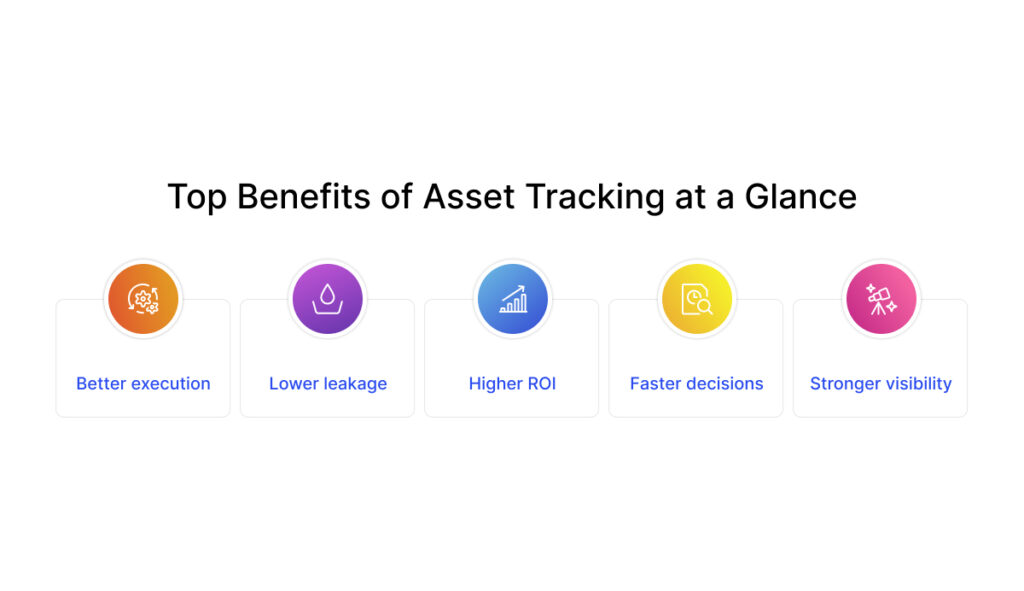
- Better decision-making with reliable store-level inputs
Understand how assets are being used across outlets and ensure they consistently contribute to in-store execution. This removes execution gaps in FMCG operations. - Stronger in-store execution that matches brand standards
Ensure assets contribute to a consistent brand presence and better shopper experience at the point of sale. - Lower financial leakage from untracked or misplaced assets
Minimise losses caused by misplaced, underutilised, or unaccounted assets across the network. This helps eliminate ghost assets in FMCG distribution. - Higher ROI on deployed assets
Ensure every deployed asset contributes to business outcomes like visibility, availability, and sales uplift. - Faster, data-driven decision making
Enable teams to act quickly based on accurate field data and evolving market conditions by using an intelligent asset management system.
With a strong retail asset management system, assets become measurable growth drivers by:
- Improving asset availability at stores
- Enhancing operational efficiency across the network
- Strengthening in-store presence and improving sell-through
Ultimately, the right retail asset management software for FMCG turns every deployed asset into a measurable, accountable, and revenue-generating unit.
Key Features of FMCG Asset Management Software (Must-Have Capabilities)
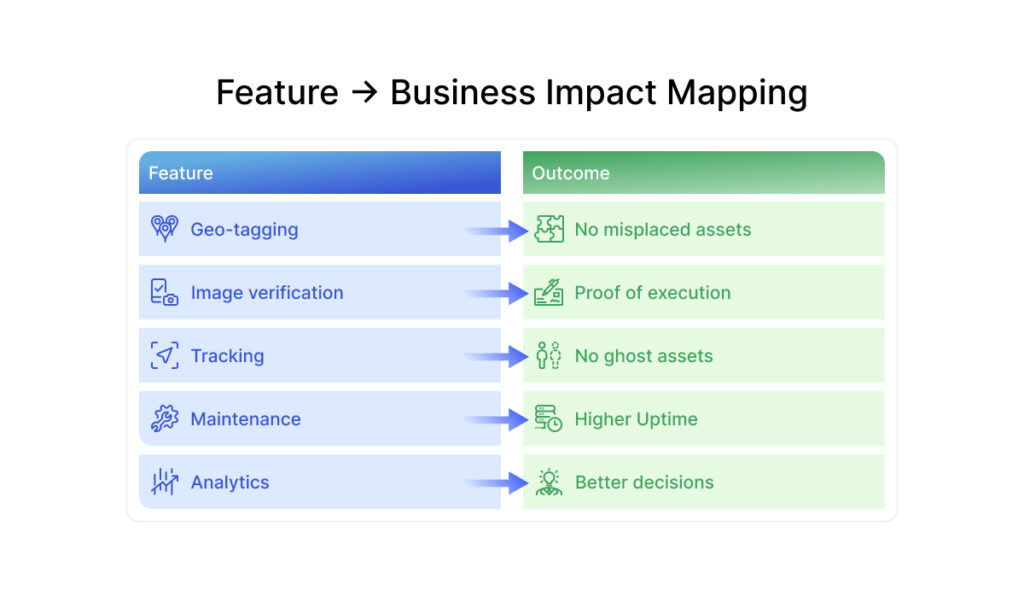
Key features of FMCG asset management software include geo-tagging, image-based verification, asset lifecycle tracking, and real-time reporting. A reliable POSM tracking software should provide outlet-level clarity, control, and accountability across your retail network. The right system helps brands track assets, verify execution, and maximise ROI at the outlet level.
- Asset Tracking and Status Monitoring – Track whether assets are present, active, or non-functional. So you can quickly identify missing, idle, or underperforming assets.
- Geo-Tagging and Mapping – Map every asset to a specific retail outlet using location data. So you always know exactly where assets are placed and avoid misplacement or duplication
- Image-BasedVerification – Capture real images during store visits to validate asset placement and condition. So you can verify execution with proof instead of relying on verbal updates
- Maintenance and Service Tracking – Log issues, assign service requests, and track resolution timelines. So assets stay functional and downtime does not impact sales
- Asset Lifecycle Management – Track assets from deployment to repair, replacement, or removal by using the Heera asset lifecycle management software.So you understand how assets perform over time and improve long-term ROI
- Reporting and Analytics – Access insights on asset usage, gaps, and performance trends. So you can make faster decisions on where to deploy or fix assets
- Outlet-Level Asset Tracking – Track exactly which assets are present at each store and their condition. So you get store-level insights instead of relying on distributor-level assumptions
- SFA Integration (Sales Force Automation) – Integrate with your retail execution software or field asset management system to connect asset tracking with on-ground sales activities and store visits. So asset management becomes part of daily execution, not a separate process
In simple terms, these capabilities ensure assets are not just deployed, but actively managed, verified, and optimised at the store level where they directly impact sales.
Why These Features Matter
Without these capabilities, even the best-planned asset deployments fail on execution.
With them, brands can:
- Eliminate ghost assets
- Improve retail execution compliance
- Ensure higher asset availability
- Drive better in-store visibility and sales
In simple terms, the right field asset tracking software for FMCG doesn’t just track assets, it ensures they actually perform where it matters most: at the store.
Use Case: Cooler Tracking Solution in Beverage Brands (Before vs After)
Cooler tracking solution in FMCG is a practical example of how asset management directly impacts retail visibility and sales. The table below shows how operations change after implementing an FMCG EAM (Enterprise Asset Management) software, a.k.a cooler tracking system for FMCG brand.
Before cooler tracking system | After Implementing cooler tracking system |
Coolers allocated to distributors with no structured tracking | Every cooler is geo-tagged to a specific retail outlet |
No clarity on actual outlet placement | Exact outlet-level asset tracking with location mapping |
No tracking of working condition or usage | Field reps capture live images for verification |
Issues identified only after sales decline | Non-working coolers flagged instantly in real time |
No structured maintenance process | Maintenance and service requests tracked and resolved quickly |
Decisions based on assumptions | Data-driven insights with live tracking |
- Higher cooler uptime ensures products are always sale-ready
- Better in-store visibility improves brand presence
- Increased secondary sales due to functional and properly placed assets
In simple terms, a cooler tracking software for FMCG transforms unmanaged assets into measurable revenue drivers by ensuring they are visible, functional, and consistently monitored at the retail level.
Ground Challenges in FMCG Asset Tracking
Even with assets deployed and systems in place, what happens on the ground is often far from controlled. FMCG brands operate in highly fragmented retail environments, where execution depends on multiple external factors. Some of the most common challenges seen across retail networks include:
- Coolers switched off by retailers
Retailers may switch off coolers to save electricity costs, especially in low-margin outlets. This directly impacts product visibility and sales, even though the asset is technically “present.” - Competitor products stored in branded coolers
In many cases, branded coolers are used to store competing products, reducing exclusivity and defeating the purpose of deployment. Without verification, this often goes unnoticed. - POSM removed or not displayed
Point-of-sale materials are frequently removed, misplaced, or never installed properly, leading to gaps in brand visibility at the store level. - Assets shifting between outlets
Coolers and racks may be moved between stores by distributors or retailers without any formal tracking, breaking the link between asset records and actual location. - Service delays, especially in rural areas
Maintenance requests often take longer to resolve in remote locations, resulting in assets remaining non-functional for extended periods.
These challenges are not exceptions; they are part of everyday field reality in FMCG. Without structured tracking and verification, most of these issues remain invisible at the management level, even though they directly impact execution and sales.
For example, consider a scenario:
An FMCG brand rolls out a festive POSM campaign across 5,000 outlets.
On paper:
- POSM materials dispatched to distributors
- Outlets marked as “covered”
- Campaign reported as successfully executed
But on the ground:
- In many stores, POSM is never installed
- Some retailers remove it after a few days
- Some materials are damaged or misplaced
- No one verifies actual display
Result:
- Campaign visibility is inconsistent
- Brand loses shelf attention during peak season
- Management believes execution was successful
What changes with POSM tracking software:
- Each POSM item is mapped to specific outlets
- Field reps upload image proof during visits
- Missing or removed POSM is flagged
- Managers see real-time compliance reports
Outcome:
Campaign execution becomes measurable, not assumed.
How Asset Tracking Improves Field Force Management in FMCG
Asset tracking gives FMCG field teams a structured, verifiable way to operate, report, and execute at the store level. Asset tracking doesn’t just improve the visibility of assets. It fundamentally changes how field teams operate, what they prioritise, and how performance is measured on the ground. The biggest impact is not operational; it’s commercial.
This becomes especially important when you look at how assets like coolers perform on the ground, because field execution directly determines whether these assets generate revenue or sit idle. For example, let’s take the cooler problem into consideration:
The Cooler ROI Problem
In FMCG, a branded cooler is not just an asset. It is a revenue-generating unit placed inside a store to drive visibility and impulse purchase.
But on the ground, the reality is very different. A cooler may be installed, but not plugged in. It may be used by the retailer to store competitors’ products. It may be pushed to a back room, or remain non-functional for months without repair.
In each of these cases, the brand continues to bear the cost of deployment and maintenance, while the asset delivers little to no sales impact.
Across large retail networks, it is commonly observed that a significant percentage of deployed coolers remain non-productive at any given time due to lack of visibility and follow-up (this range should be validated before publishing).
The core value of asset tracking is not just knowing where assets are, but ensuring they are actively contributing to sales.
This is where asset tracking moves beyond visibility and becomes critical to field force performance and revenue outcomes.
For example, consider a scenario:
A beverage brand installs a visi-cooler at a high-footfall kirana store.
On paper:
- Cooler is deployed
- Outlet is covered in beat plan
- Distributor confirms placement
- Sales rep marks visit as completed
Everything looks correct in reports.
But on the ground:
- The cooler is switched off to save electricity
- It’s placed near the back, not visible to customers
- The retailer is using it to store competitor products
Result:
- The brand assumes visibility is strong
- The asset is marked “active” in the system
- Secondary sales from that outlet decline
What changes with visi-cooler tracking system:
- Geo-tagging confirms the correct outlet
- Image capture shows placement and usage
- Non-compliance (switched off / wrong products) is flagged instantly
- Field rep is assigned a corrective task
Outcome:
The same asset goes from being a cost center to a functioning sales driver.
Key Ways Asset Tracking Improves Field Operations
- Clear Task Direction for Field Teams
Field reps know exactly which assets are assigned to which outlets. This removes confusion and improves execution during store visits. - Stronger Accountability with Proof-Based Reporting
With image-based verification and geo-tagging, managers can verify execution with proof on the ground. Proof-based reporting eliminates false entries and builds accountability across the field team. - Better Visit Planning and Coverage
Teams can prioritise outlets with missing, damaged, or non-functional assets. The result is smarter routing and more productive store visits. - Faster Issue Identification and Resolution
Field reps can instantly flag issues such as non-working retail assets or missing POSM. Teams address issues quickly, reducing asset downtime. - Improved Retail Execution Compliance
Ensures that displays, branding, and assets are correctly placed and maintained as per brand guidelines. - Data-Driven Performance Tracking
Managers can monitor field performance, asset status, and execution quality through a unified field asset management system. - Seamless Integration with Sales Workflows
When connected with retail execution software or SFA, asset tracking becomes part of daily field operations, not a separate task.
Field Force Management: Before vs After Asset Tracking
Area | Without Asset Tracking System | With Asset Tracking System |
Store Visits | Marked complete without validation | Verified with scans and images |
Asset Visibility | Assumed or delayed | Near Real-time, outlet-level |
Cooler Usage | No visibility | Actively monitored |
Issue Resolution | Delayed | Immediate flagging |
Reporting | Verbal/manual | Proof-based |
The Business Impact
Without asset tracking, field teams operate reactively, with limited visibility and unclear priorities.
With a structured FMCG cooler tracking system, brands can:
- Improve field productivity and efficiency
- Ensure better retail execution at the outlet level
- Reduce reporting gaps and delays
- Strengthen control over on-ground operations
In simple terms, asset tracking transforms field force management from activity-based to outcome-driven, where every store visit is measurable, verifiable, and aligned with business goals.
How Asset Tracking Works in a Typical FMCG Field Day
To understand how asset tracking works in practice, it helps to look at what a typical day looks like for a field sales representative.
Task 1 – Beat Plan Starts
The sales rep begins the day with a predefined beat plan. Along with outlets to visit, the system highlights specific assets (coolers, racks, POSM) that need verification.
Task 2 – First Store Visit
At the outlet, the rep:
- Scans the asset QR code
- Confirms the outlet location (geo-tagged)
- Checks if the cooler is present and switched on
- Verifies whether POSM is displayed correctly
Task 3 – Image-Based Verification
The rep captures images of:
- Cooler condition and placement
- Product stocking inside the cooler
- POSM visibility
This acts as proof of execution and removes guesswork from reporting.
Task 4 – Issue Flagged
At the next outlet:
- Cooler is present but not working
- POSM is missing
The rep logs the issue instantly:
- Marks cooler as “non-functional”
- Raises a service request
- Flags missing POSM for replacement
Task 5- Smart Prioritisation
The system automatically highlights:
- Outlets with non-functional assets
- Stores with repeated compliance issues
This helps the rep prioritise high-impact visits instead of just following a static route.
Task 6- Manager Visibility
At the backend, managers can see:
- Which assets were verified
- Which outlets were compliant
- Where issues were reported
All backed by location data and images.
End of Day – No Manual Reporting
There’s no need for separate reporting.
Every action taken during the day is already captured, verified, and available in near real time. Instead of:
- Assumed execution
- Delayed updates
- Manual reporting
Kirana store asset tracking creates:
- Real-time visibility
- Proof-based execution
- Faster issue resolution
In simple terms:
Kirana asset tracking turns daily field activity into structured, verifiable execution that directly impacts sales.
FMCG Asset Tracking Best Practices: 7 Processes Every Brand Should Follow
What Is a Ghost Asset in FMCG?
A ghost asset is a physical asset – such as a cooler, rack, or POSM unit – that exists in a company’s records or asset register but is missing, misplaced, non-functional, or no longer present at its assigned outlet.
Ghost assets lead to:
- Inaccurate asset registers and inflated inventory counts
- Maintenance costs paid on non-existent or non-functional assets
- Missed sales opportunities at outlets where assets should be present
- Financial leakage across large distribution networks
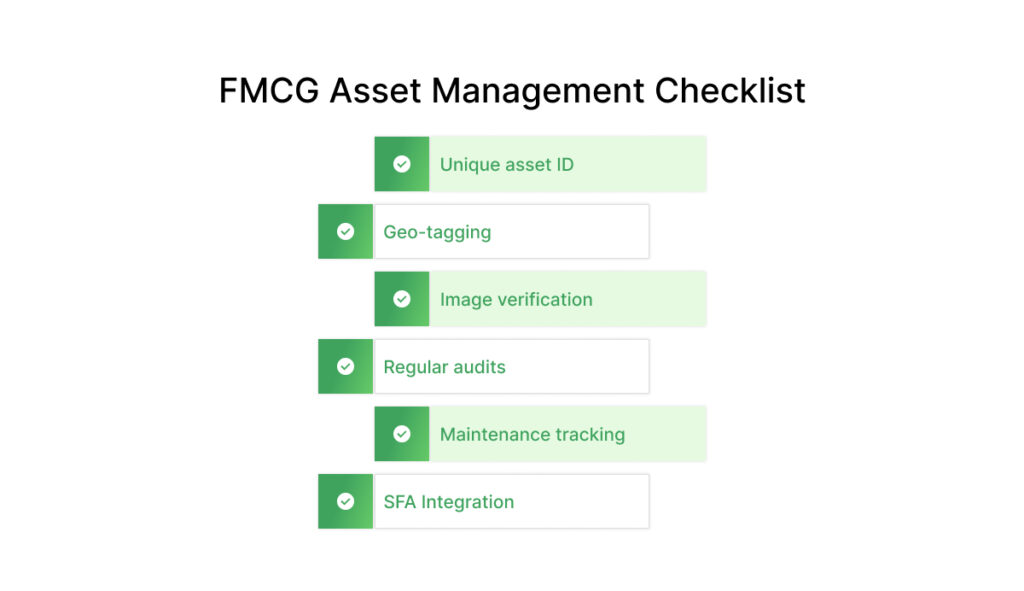
Having the right software is only part of the solution. The real impact comes from how asset tracking management in FMCG is implemented on the ground. Based on real FMCG execution challenges, here are the practices that actually make asset tracking work at scale.
- Standardise Asset Allocation and Tagging
Every asset should be assigned a unique ID using QR codes, barcodes, RFID, or NFC, depending on the use case. This creates a clear link between the physical asset and its digital record.
On the ground, this is what prevents duplication, confusion, and loss of visibility, especially when assets move across outlets or distributors. Without a unique identifier, tracking quickly breaks down as scale increases.
This is the foundation of any asset management system. Without proper tagging, everything else becomes unreliable.
Common mistake: Tagging assets but not ensuring they are consistently scanned during field visits, leading to outdated or incomplete data.
QR Code vs Barcode for Asset Tagging in FMCG
Aspect | QR Code Tagging | Barcode Tagging |
Data Capacity | Can store more data (asset ID, outlet info, batch details) | Efficient for storing essential identifiers like asset IDs in a simple format |
Scanning Speed | Fast and flexible, can be scanned from multiple angles | Quick and reliable when scanned with proper alignment |
Ease of Use in Field | Easily scanned using standard smartphone cameras | Works smoothly with handheld scanners and structured workflows |
Use in FMCG Field Conditions | Well-suited for dynamic retail environments and field visits | Performs best in controlled environments like warehouses and storage units |
Cost of Implementation | Low-cost and easy to deploy at scale | Cost-effective, especially where scanner infrastructure already exists |
Adoption in India FMCG | Commonly used for retail and outlet-level tracking | Widely used in supply chain, warehousing, and logistics operations |
Best Use Case | Outlet-level tracking (coolers, POSM, racks) | Inventory, warehouse, and back-end asset tracking |
In simple terms:
QR codes are more flexible and field-friendly, which is why most FMCG brands in India prefer them for asset tracking.
- Use Geo-Tagging for Every Deployment
Geo-tagging ensures that every asset is mapped to a specific outlet using location data captured during field visits. This creates a fixed reference point for where the asset is supposed to be.
In practice, this helps prevent assets from being moved between stores without visibility, a common issue in distributor-led networks. It also acts as a validation layer for field activity, confirming that visits are happening at the correct location.
This becomes critical during audits, where location accuracy directly impacts decision-making.
Common mistake: Capturing location only during installation and not updating it during regular audits, resulting in outdated records.
- Capture Image-Based Proof of Execution
Images provide visual confirmation that assets are installed, visible, and being used correctly in-store. This adds a layer of verification that cannot be achieved through text-based reporting alone.
On the ground, this helps validate whether coolers are switched on, whether branding is correctly placed, and whether displays are set up as planned. It also reduces dependency on verbal updates from field teams.
Over time, image data becomes a reliable audit trail for compliance and execution quality.
- Track Asset Health and Maintenance Regularly
Tracking location is only one part of the problem. Assets also need to be monitored for usage and condition to ensure they are actually contributing to sales. This is critical for cooler tracking systems for FMCG brands in India, where uptime directly affects sales.
In reality, many assets remain underutilised, switched off, or poorly maintained without being flagged. Regular condition checks during field visits help identify these gaps early.
This ensures that assets are not just present in the market, but actively supporting retail execution and visibility.
- Eliminate Ghost Assets with Regular Audits
Ghost assets are assets that exist in records but cannot be physically verified on the ground. These create a false sense of coverage and distort performance tracking
In large FMCG networks, this typically happens due to poor tracking, asset movement, or inaccurate reporting over time. Regular verification through scans and image proof helps identify such assets.
Eliminating ghost assets improves data accuracy and ensures that decisions are based on actual ground reality, not assumptions.
- Integrate Asset Tracking with Field Sales Activities
Asset tracking should not operate as a separate process. It needs to be embedded into regular field sales activities such as store visits, audits, and promoter workflows.
In practice, this means assets are scanned, verified, and reported during routine beat visits, rather than through standalone tracking exercises. This improves compliance without increasing workload for field teams.
This integration is what connects asset visibility to actual retail execution and sales outcomes. Without it, asset management remains a static record instead of a system that drives performance.
Common mistake: Treating asset tracking as an additional task, leading to low adoption and inconsistent data capture.
- Use Analytics to Measure Asset Performance and ROI
The real value of asset management comes from understanding how assets impact business outcomes. This requires moving beyond tracking to analysing performance data.
By linking asset data with sales, brands can identify which assets are driving visibility and which are underperforming. This helps prioritise maintenance, relocation, or redeployment decisions.
Over time, this shifts asset management from a tracking exercise to a strategic function that directly influences ROI and execution efficiency.
Without clear processes, even the best retail asset management software for FMCG fails to deliver results.
Following these practices helps brands:
- Improve asset availability across outlets
- Close operational gaps in FMCG supply chains
- Ensure consistent retail execution
- Maximise returns from every deployed asset
In short, strong execution combined with the right retail asset management system ensures assets are not just tracked, but actively contributing to growth.
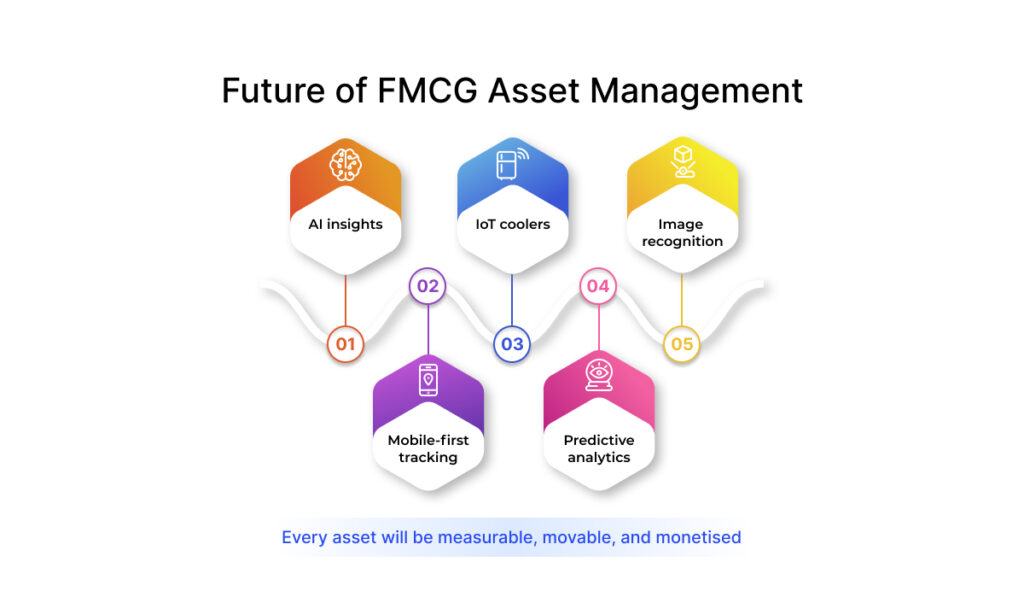
Latest Trends in FMCG Asset Management in India: What Leading Brands Are Adopting
Asset management in FMCG is reshaping how brands track and manage assets across their retail networks, but adoption is not uniform across markets. In India, most brands are still transitioning from manual or semi-digital processes to structured systems. While global trends like IoT and AI are gaining attention, the reality on the ground is that adoption is layered, with different brands at different stages of maturity.
Shift from Manual Tracking to Structured Digital Systems
Many FMCG brands still rely on Excel sheets, WhatsApp updates, or distributor-level reporting to track assets. This is now shifting toward mobile-based systems that provide outlet-level visibility and structured data capture. This transition is the most significant change happening in India today, as brands move away from assumptions toward real-time tracking.
QR Code-Based Asset Tracking Becoming the Standard
QR code tagging is currently the most widely adopted and practical approach for asset tracking in India. It is affordable, easy to deploy, and works seamlessly with entry-level Android devices used by field teams. For most mid-sized FMCG brands, QR-based tracking is the starting point for building a scalable asset management system.
Integration with Field Sales and Retail Execution Systems
Asset tracking is increasingly being integrated with sales force automation (SFA) and retail execution tools. This allows asset verification to happen during regular store visits, rather than as a separate activity. This trend is important because it improves adoption and directly links asset visibility with sales execution.
Growing Use of Image Recognition for Compliance
Advanced systems are using image recognition to automatically verify display compliance and branding visibility, improving POSM compliance tracking. This includes identifying whether coolers are stocked correctly, whether POSM is displayed, and whether branding guidelines are followed. While still evolving in India, this is gaining traction among larger brands and tech-forward teams.
Early Adoption of IoT-Enabled Asset Monitoring
IoT-enabled coolers and smart devices can track parameters like temperature, usage, and uptime in real time. However, in India, adoption is still at an early stage and largely limited to pilots by large enterprises. For most brands, cost and infrastructure constraints mean that IoT is not yet a mainstream solution.
Transition from Reactive to Predictive Asset Management
Traditional asset management is reactive; issues are identified after impact execution. With better data and analytics, brands are starting to predict failures, optimise servicing schedules, and improve asset utilisation proactively.
While still emerging, this represents the direction in which asset management is evolving.
Use of WhatsApp and Informal Tools as Interim Solutions
Many smaller FMCG brands use WhatsApp groups and manual updates to track assets and share field information. While this helps bridge the gap between manual and digital processes, it lacks structure, consistency, and scalability. This often becomes the starting point before brands move to dedicated asset management systems.
As FMCG brands in India continue to scale their retail networks, the focus is shifting from basic tracking to intelligent, integrated systems that connect asset visibility with execution and revenue outcomes. The future of asset management for FMCG brands is now also about optimisation and accountability.
Brands that adopt these trends early will be able to:
- Improve secondary sales visibility
- Reduce inefficiencies in field operations
- Ensure better retail execution at scale
- Build a more data-driven FMCG operation
In simple terms, asset tracking is moving from reactive monitoring to proactive optimisation, where systems not only show what’s happening, but also guide what to do next.
How to Choose the Best FMCG Asset Management Software in India: A Buyer's Framework
The best asset management software for FMCG businesses is not defined by brand name, but by how effectively it solves real on-ground challenges like asset visibility, tracking, and retail execution.
For FMCG companies operating across large distribution networks in India, the right solution should combine asset tracking, field execution, and real-time reporting into a single system.
What Defines the Best FMCG Asset Management Software?
To choose the right solution, FMCG brands should look for the following capabilities:
- Outlet-Level Clarity
The software should provide live tracking of assets across distributors, warehouses, and retail stores to eliminate visibility gaps. - Outlet-Level Asset Tracking
Every asset should be mapped to a specific outlet for accurate, accountable monitoring. - Geo-Tagging and Image Verification
The system should support geo-tagging and image capture to validate placement and ensure POSM compliance tracking. - Integrated Field Asset Management system
Asset tracking should relate to field activities like store visits, audits, and reporting for complete control. - Maintenance and Lifecycle Management
The asset lifecycle management software should be able track asset condition, service history, and lifecycle to reduce downtime and extend usability. - Scalability Across Large Distribution Networks
FMCG businesses need systems that can handle thousands of outlets, multiple distributors, and large field teams. - Advanced Reporting and Analytics
Insights into asset usage, gaps, and performance help improve secondary sales visibility and decision-making. - Integration with FMCG Systems (SFA / DMS / ERP)
The software should integrate with existing distributor management systems, sales force automation solutions and more such to create a unified view of operations. Modern systems often combine inventory, sales, and distribution data for better efficiency.
FMCG operations in India are highly distributed and complex. Without the right system:
- Assets remain untracked or underutilised
- Field execution gaps go unnoticed
- Decisions rely on delayed or inaccurate data
Modern solutions use technologies like mobile apps, QR/RFID tagging, and real-time dashboards to improve tracking, reduce losses, and enable faster decision-making.
Asset Tracking Software Pricing in India: Cost & Factors Explained
The cost of a field asset tracking software for FMCG companies in India varies widely depending on business sise, complexity, and required features. Instead of a fixed price, most solutions follow a flexible pricing model based on usage and scale.
Understanding what drives pricing helps FMCG brands choose the right solution without overspending.
Key Factors That Affect Pricing
- Number of Users (Field Team Size)
Pricing often depends on how many sales reps, promoters, or managers will use the system. Larger field teams typically mean higher costs. - Number of Assets Being Tracked
Tracking thousands of assets across outlets requires more data handling, which impacts pricing for FMCG asset tracking system (ats). - Feature Requirements
Basic tracking costs less, while advanced features like image-based verification, geo-tagging, and asset lifecycle management increase pricing. - Level of Automation and Intelligence
Systems with AI-driven insights, predictive analytics, and intelligent asset management capabilities are priced higher. - Integration with Existing Systems
Integrating with SFA, Distribution Management System, or ERP systems adds to implementation complexity and cost. - Deployment Scale (City vs Pan-India)
A solution used across a few cities will cost less than one deployed across a nationwide distribution network. - Customisation and Support
Custom workflows, dashboards, and dedicated support services can influence the overall cost.
Pricing Models You’ll Typically See
Most retail asset management software in India follows one of these models:
- Per User (Per Month)
Based on the number of active users in the system - Per Asset Tracked
Pricing linked to the volume of assets managed - Subscription-Based (SaaS Model)
Monthly or annual pricing based on features and usage - Custom Enterprise Pricing
Tailored pricing for large FMCG brands with complex requirements
How to Evaluate Cost vs Value
Instead of focusing only on price, FMCG brands should evaluate:
- Will this improve actual field visibility?
- Can it reduce asset losses and leakage?
- Does it improve secondary sales visibility and retail execution?
- Will it reduce manual effort and reporting delays?
The Bottom Line
The right Visi Cooler Management System for FMCG is not the cheapest option; it’s the one that delivers measurable ROI.
If a system helps you:
- Prevent asset loss
- Improve outlet-level execution
- Increase product visibility
…it quickly pays for itself.
In simple terms:
Don’t just ask “What does it cost?” – ask “What does poor asset visibility cost today?”
FMCG Asset Management Software in India: How Heera Software Helps
FMCG brands looking for a field asset tracking software in India typically need three things: accurate outlet-level tracking, proof-based verification, and integration with field sales. Heera Software is built to address these requirements. Heera Software helps FMCG brands track, verify, and manage assets across the retail network while ensuring they contribute to actual in-store execution and sales outcomes.
Outlet-level asset visibility
Monitor the exact location and status of assets like coolers, racks, and POSM with complete live tracking.
Ensure POSM Compliance with Image-Based Verification
Get on-ground validation through live images captured by field teams, ensuring accurate POSM compliance tracking.
Monitor Asset Utilisation and Performance at Store Level
Identify non-functional or underutilised assets and take immediate action using a structured field asset management system
Connect Asset Tracking with Retail Execution and Field Sales Activities
Asset verification is added to daily store visits, so field teams verify assets while doing their regular work instead of treating it as a separate task.
Maintenance and issue tracking
Field teams can log issues instantly, with clear tracking of resolution timelines to reduce asset downtime.
Performance and ROI insights
Understand which assets are contributing to visibility and which require relocation, servicing, or replacement.
For example, a leading beverage brand managing over 3,000 coolers across India used Heera to gain outlet-level visibility into asset usage. Within the first few months, the team was able to identify non-functional and misused coolers that were previously untracked, enabling faster corrective action and improved in-store execution.
This is especially useful for FMCG brands managing large distributor networks, where cooler tracking, POSM tracking, and tracking retail assets at scale become difficult without a centralised system.
Is Heera Right for Your Business?
Heera is typically a strong fit if:
- You manage many assets across multiple retail outlets
- You lack clear visibility into asset usage, condition, or placement
- Your field teams rely on manual or WhatsApp-based reporting
- You want to connect asset tracking with retail execution and sales outcomes
If these challenges sound familiar, a structured asset management system can significantly improve visibility and performance.
If you’re looking for asset tracking software for FMCG companies in India that improves both control and execution, Heera Software helps you move from basic tracking to measurable on-ground performance and turn every deployed asset into a tracked, accountable, and revenue-generating unit.
In FMCG, assets like coolers and POSM directly impact retail visibility and sales. But the real challenge isn’t deploying them, it’s knowing where they are, whether they’re working, and if they’re actually driving value. Without a structured asset management system, brands rely on assumptions, leading to asset loss, poor execution, and missed sales opportunities. A modern asset-tracking software for FMCG solves this by providing continuous on-the-ground tracking, image-based verification, and store-level asset control. It ensures assets are actively managed throughout their lifecycle, properly used, monitored, and optimised.
With the right system, brands can:
- Improve retail execution and compliance
- Reduce asset leakage and downtime
- Increase field team accountability
- Drive higher secondary sales
If you’re looking for an asset tracking system (ats) for FMCG that not only tracks assets but also improves retail execution, Heera Software is designed to deliver exactly that. It helps brands move from limited visibility to complete on-ground clarity, where every asset is tracked, verified, and contributing to sales
Frequently Asked Questions
Asset management in FMCG refers to tracking and managing physical assets like coolers and POSM across retail outlets to ensure they are properly used, maintained, and delivering value.
Asset tracking helps prevent losses, improve retail execution, and ensure assets like coolers and displays are functional, directly impacting product visibility and sales.
Common FMCG assets include coolers, freezers, display racks, POSM materials, signage, and delivery of vehicles deployed across retail outlets.
Companies use the field asset tracking software with geo-tagging, field verification, and image capture to monitor asset location, condition, and usage in real time.
An asset management system is a software solution that helps businesses track, manage, and optimise assets throughout their lifecycle, from cooler deployment tracking to maintenance and replacement and cooler management.
A ghost asset, a.k.a. ghost asset management in FMCG, is an asset that exists in records but is missing, misplaced, or not actually present at the assigned outlet, leading to inaccurate reporting and losses.
FMCG companies track assets across multiple outlets using asset management software with geo-tagging, image-based verification, and field reporting. This allows brands to monitor asset location, condition, and usage at the store level in real time.
The best way to track visi-coolers in FMCG distribution is by using a cooler tracking software with geo-tagging, image capture, and maintenance tracking. This ensures coolers are functional, correctly placed, and consistently contributing to product visibility and sales.
POSM tracking software improves retail execution by ensuring assets like coolers and POSM are properly placed, visible, and functional at retail outlets. It provides on-ground data that helps teams fix execution gaps quickly.
The cost of asset tracking solution for FMCG in India depends on factors like the number of users, assets tracked, features required, and deployment scale. Most solutions follow a subscription-based pricing model, with custom pricing for large enterprises.
1. Yes, most modern FMCG asset management software can integrate with SFA (Sales Force Automation) and DMS (Distributor Management Systems). This helps connect asset tracking with field sales activities and distributor operations.
ROI on FMCG assets can be measured by tracking asset utilisation, uptime, placement accuracy, and impact on secondary sales. Asset management systems provide data to link asset performance with sales outcomes.
Yes, asset management software can be scaled for small and mid-sized FMCG businesses. Even with fewer outlets, it helps improve control, reduce losses, and ensure better retail execution.
To implement FMCG chiller tracking systems (CTS), the time depends on the size of the business and the complexity of operations. For most FMCG companies, basic setups can take a few weeks, while large-scale deployments may take longer.
Asset tracking tells you where your FMCG assets are and their status (location, condition, usage). Asset management goes further. It uses that data to optimise performance, plan maintenance, and ensure assets drive sales and visibility. In short, tracking shows location; management shows value.
Asset tracking software connects to a distributor management system (DMS) via APIs or data sync. This links asset data (deployment, movement, usage) with distributor data like outlet mapping and sales. In short, it helps brands tie asset visibility directly to secondary sales and distribution execution.